

How much does it cost to build a house in 2026?
Building a house in Europe in 2026 is a significant financial commitment, but it remains one of the most rewarding investments a family can make. After years of volatile material prices and pandemic-driven supply chain disruptions, the European construction market has settled into a period of relative cost stability. Material prices have plateaued, interest rates are gradually easing, and new EU energy regulations are reshaping what a "standard" new home actually looks like. Yet the question every prospective homebuilder asks remains surprisingly difficult to answer: how much will it actually cost? The figure depends on dozens of variables — from the region you build in and the construction method you choose, to the energy standard you target and the quality of your building envelope. This guide breaks down every major cost factor, provides realistic 2026 price ranges, and explains why your choice of windows and doors matters far more than most budgeting guides suggest.
The state of European construction costs in 2026
The years 2021 and 2022 brought sharp construction cost inflation across Europe, with many markets experiencing 15–25% price increases driven by soaring timber, steel, and energy costs. By late 2023, material prices began stabilising, and 2024–2025 saw cost inflation moderate to around 2–3% annually. Industry forecasts for 2026 point to continued stability with modest growth of roughly 1.5% in overall construction output — welcome news for anyone planning a new build.
However, “stable” does not mean “cheap.” The baseline cost of a new home has permanently shifted upward. EU regulations now mandate highly insulated envelopes, advanced mechanical ventilation, and in many cases renewable energy integration as standard. What was considered a premium passive house specification just a few years ago is rapidly becoming the regulatory minimum across the continent.
Average house building costs per square metre in 2026
Construction costs vary across Europe, but for the typical Western and Northern European homebuilder — which covers the vast majority of new single-family construction activity — the ranges are broadly comparable. In 2026, building a turnkey, standard-to-good specification detached family home in most Western European markets costs roughly 2,800 to 4,500 EUR per square metre, excluding land purchase.
Where exactly your project falls within that range depends on several interacting factors. Major urban centres and their commuter belts push toward the upper end, while suburban and rural locations sit lower. High-specification finishes, complex architectural geometry, and premium MEP systems (ground-source heat pumps, underfloor heating, photovoltaic arrays) all drive costs upward. Simple, compact designs with standard finishes can keep budgets closer to the lower boundary.
For a practical reference: a well-specified 150 m² family home in Western Europe might cost between 420,000 and 675,000 EUR for construction alone, depending on location, specification level, and the complexity of the site.
What drives cost differences across Europe?
The single biggest variable is labour. Building materials — bricks, concrete, steel, glass — cost broadly the same across the EU single market thanks to integrated supply chains. What differs dramatically is the cost of the skilled tradespeople who assemble them. A qualified electrician or plasterer in a high-cost Western European city earns significantly more than one in a lower-cost region, and this labour differential cascades through every phase of the build.
This economic reality creates a meaningful opportunity for cross-border sourcing of manufactured components. Items like windows, doors, and facade systems — where material quality and engineering precision are paramount but transport costs are proportionally low — can deliver substantial savings when sourced from specialist manufacturers in competitive production markets, provided they meet identical CE-marked standards and carry full European certification.
How building form affects your budget
The fundamental geometry of the building affects the baseline cost before a single material is specified. A single-storey bungalow, while avoiding complex staircases and upper-level scaffolding, requires a larger foundation footprint and more extensive roof area to achieve the same living space as a two-storey home. Given that groundworks and roofing are capital-intensive phases, a compact two-storey footprint is typically 5–15% more cost-efficient per square metre.
The historic cost gap between traditional masonry and timber frame construction has effectively closed in 2026. Both methods present comparable overall project costs, with the choice now driven by embodied carbon calculations, thermal bridging analysis, acoustic performance, and on-site programme speed rather than outright financial savings.
Phase-by-phase breakdown of new build house costs
Understanding where your money goes at each construction phase is essential for effective budgeting. A typical turnkey single-family home breaks down into the following approximate cost shares.
Site preparation, groundworks, and foundations (10–20%)
This is the most variable phase. Standard strip foundations on stable soil sit at the lower end of the budget range, while poor ground conditions requiring engineered raft foundations or piled solutions can push sub-structure costs up by 50–100%. Including a full basement adds substantial cost, but on expensive plots it can be mathematically rational — delivering roughly 30% more usable volume for a 15–18% increase in the structural budget.
Superstructure: walls, floors, and roof (25–35%)
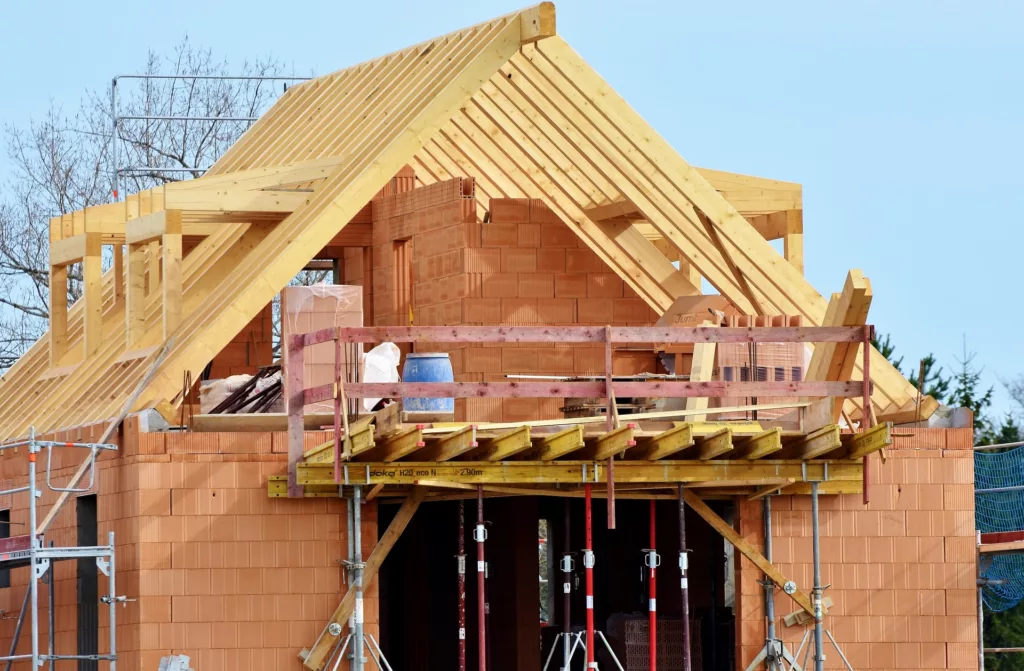
Erecting the structural frame — whether from precision-engineered timber, aerated concrete blocks, or insulating concrete formwork — consumes a quarter to a third of the budget. This phase establishes the building’s core airtightness and structural integrity, fundamentally dictating its long-term energy performance.
Roofing and weatherproofing (8–12%)
Simple gable roofs sit at the lower end. Complex geometries with multiple valleys, hips, and dormers significantly increase both material and labour costs. This phase includes roof-level insulation, critical to the building’s overall thermal envelope.
The building envelope: windows and external doors (10–15%)
This is the critical barrier between interior comfort and exterior elements. The specification of fenestration — windows, entrance doors, and patio doors — dictates the structure’s thermal success, acoustic comfort, security, and architectural character. This category deserves its own detailed section below.
Mechanical, electrical, and plumbing (15–20%)
MEP is the fastest-inflating cost category in 2026. The regulatory shift from simple boilers to air-source or ground-source heat pumps, combined with mandatory mechanical ventilation with heat recovery (MVHR), underfloor heating, and integrated photovoltaic arrays, demands specialised labour and sophisticated equipment.
Internal fit-out and finishes (15–25%)
The most elastic budget category, covering plastering, flooring, staircases, cabinetry, kitchens, and bathrooms. This is where specification creep most commonly occurs — and where disciplined budgeting matters most, because overspending on finishes often forces last-minute value engineering on the building envelope. That is precisely the wrong trade-off for long-term performance.
The building envelope: budgeting for windows and doors in a new build
Here is where most construction cost guides fall short. Windows and doors are routinely grouped under vague headings like “exterior finishes,” obscuring the fact that they represent one of the most strategically important budget allocations in the entire project.
What percentage of the build budget goes to windows and doors?
Industry data consistently places windows and external doors at 10–15% of total construction cost for a new single-family home. For a house costing 450,000 EUR to build, that translates to a fenestration budget of 45,000–67,500 EUR — a substantial sum that directly determines the building’s thermal performance, acoustic comfort, security, and architectural character for the next 30–50 years.
Yet this 10–15% has a disproportionate impact on lifecycle costs. Heat lost or gained through the building envelope accounts for up to 30% of a home’s total heating and cooling energy consumption. Specifying high-performance windows and doors is therefore the single most effective way to reduce energy bills, achieve a superior Energy Performance Certificate (EPC) rating, and comply with increasingly strict EU regulations.
How much do windows cost in a new build in 2026?
For standard PVC windows with triple glazing in a reference size (approximately 1230 × 1480 mm), prices in 2026 typically range from 300 to 550 EUR per unit, depending on the profile system, colour, and glazing specification. Professional thermal bridge-free installation adds 15–25% to the product cost.
Aluminium windows command a premium, ranging from approximately 450 to 1,000 EUR per square metre of glazing area for thermally broken systems with triple glazing. The higher investment reflects aluminium’s superior structural rigidity, minimal frame sightlines, and suitability for large-format architectural glazing that PVC profiles cannot structurally support.
PVC vs aluminium windows: which material for your new build?
The choice between PVC and aluminium is not simply about price — it is about matching the material to your architectural ambitions and performance requirements.
Premium PVC systems deliver exceptional thermal performance at a competitive price point. A modern 6-chamber PVC profile with 82.5 mm installation depth, such as the GEALAN S9000, achieves a thermal transmittance coefficient (Uw) from 0.71 W/(m²K) with triple glazing — a value certified by the Passive House Institute in Darmstadt. More budget-conscious 6-chamber systems at 74 mm depth, like the GEALAN S8000, still achieve Uw from 0.78 W/(m²K), comfortably exceeding current building regulation thresholds. Both deliver acoustic insulation up to 47–50 dB and certified security to RC2. Technologies like STV® (Static Dry Glazing) and IKD® (Intensive Core Insulation) eliminate thermal bridges within the profiles themselves, pushing performance levels that were considered exceptional just a few years ago into the standard specification range.
Aluminium becomes the material of choice when projects demand expansive glass facades, floor-to-ceiling panoramic windows, or ultra-slim frame profiles. Premium aluminium window systems achieve Uw from 0.62 W/(m²K) with acoustic insulation up to 49 dB and security ratings to RC3 or even RC4 — fully meeting passive house standards while enabling architectural designs that PVC simply cannot replicate. Advanced three-chamber aluminium profiles with polyamide thermal breaks and aerogel insulation have thoroughly debunked the old myth that aluminium means cold, poorly insulated frames.
Both materials, when correctly specified with triple glazing and thermal bridge-free installation, comfortably meet the performance levels required for NZEB and Zero-Emission Building compliance across Europe.
Entrance doors: security, insulation, and design
External entrance doors are your home’s first line of defence and its most visible architectural element. They must simultaneously deliver thermal insulation, security certification, acoustic performance, and design impact — a demanding combination that justifies careful specification.
PVC entrance doors with multi-point locking systems and German-engineered panels from manufacturers like Rodenberg or Adeco start from around 1,500 EUR. The GEALAN S9000 door system achieves Ud from 0.74 W/(m²K), representing outstanding thermal performance for a PVC construction, with security certification available to RC3.
Aluminium entrance doors offer greater design freedom, structural rigidity, and are available in over 300 colour and material combinations including ceramics, architectural concrete, natural wood, and corten steel. Premium aluminium door systems achieve Ud from 0.5 W/(m²K) — among the lowest values available in the European market — with security ratings to RC3 and sound insulation up to 44 dB. German door panels with advanced PU foam cores deliver thermal transmittance values as low as 0.18–0.3 W/(m²K) for the panel element alone. Prices for high-specification aluminium entrance doors typically range from 2,500 to 5,000 EUR installed, depending on size, security class, and panel design.
Patio and terrace doors: choosing the right system
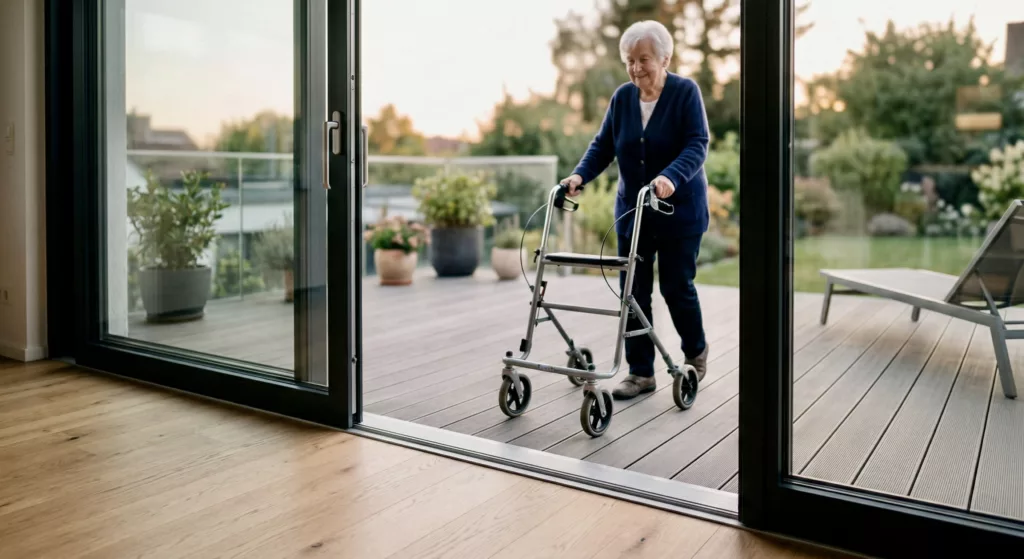
Modern European residential architecture increasingly centres on seamless transitions between indoor and outdoor living spaces. The patio door system you choose fundamentally affects how you use and experience your home every day, and each system has distinct advantages depending on your priorities.
Lift-and-slide (HST) doors are the premium solution, supporting massive glass panels of up to 14 m² and offering barrier-free, flush-threshold passages. They operate with exceptional ease — a turn of the handle lifts the panel a few millimetres, and even elements weighing over 400 kg glide effortlessly on precision hardware. HST systems achieve Uw values from 0.7 W/(m²K) in aluminium and below 0.8 W/(m²K) in PVC, with acoustic insulation up to 47 dB. Prices typically start from 3,000 EUR for standard PVC configurations and range to 6,500 EUR and above for large aluminium systems with automation and low-threshold solutions.
Parallel-slide-and-tilt (PSK) doors represent a more budget-conscious option that still delivers excellent performance. The PSK system’s key advantage is its tilt function, allowing secure ventilation without fully opening the door — a feature that HST systems do not offer. Modern PSK doors achieve Uw below 0.8 W/(m²K) with triple glazing and are available in widths up to approximately 3,300 mm. Standard PSK configurations with installation start from roughly 1,200 to 2,500 EUR, making them an accessible choice for standard balcony and patio openings.
Folding (bi-fold) doors deliver the most dramatic spatial effect, enabling up to 95% of the opening width to be cleared by stacking panels to one side. Aluminium folding systems are ideal for creating the spectacular “disappearing wall” experience, with U-values from 0.9 W/(m²K) and acoustic insulation reaching 45 dB. They work particularly well for wide openings up to 6 metres. Prices range from roughly 10,000 to over 30,000 PLN depending on size and specification.
The choice between these systems depends on your architectural vision, the size of the opening, ventilation requirements, and budget. Many homebuilders combine two or more system types within a single project — for example, large HST or folding doors for the main terrace opening and a PSK system for bedroom balconies.
Navigating EU energy regulations and EPBD 2024
The revised Energy Performance of Buildings Directive (EPBD 2024) represents the most significant legislative shift in European construction history. Its central mandate is that all new residential buildings must be designed as Zero-Emission Buildings (ZEBs) by 2030, with public buildings reaching this standard by 2028. Member states are required to transpose these directives into national law by May 2026 — making this legislation directly relevant to anyone planning a new build right now.
What Uw value do I need for new build windows in 2026?
National implementations of the EPBD vary by climate zone, but the direction is consistent across the continent. Most EU member states now require windows in new residential buildings to achieve Uw values in the range of 0.8 to 1.3 W/(m²K), with colder climate zones typically requiring 0.8–1.0. Many national subsidy programmes set even stricter thresholds — requiring Uw ≤ 0.95 W/(m²K) for windows to qualify as “high-efficiency components” eligible for grants or preferential financing.
Window and door systems achieving Uw values of 0.5–0.78 W/(m²K), as available in premium PVC and aluminium ranges, do not merely meet every current European requirement. They provide substantial headroom against future regulatory tightening — protecting your investment against standards that will only become stricter over the coming decades.
The shift toward Whole-Life Carbon assessment
Beyond operational energy, the EPBD introduces Whole-Life Carbon (WLC) assessment, meaning the embodied carbon of construction materials must be calculated and disclosed for new buildings. This fundamentally shifts the value equation: investing more in a high-performance building envelope that minimises operational heat loss for 30–50 years becomes the optimal strategy, even when accounting for the higher embodied carbon of triple glazing and advanced frame profiles. The energy saved over a building’s lifetime vastly outweighs the additional embodied carbon of premium fenestration.
European subsidy programmes for energy-efficient new builds
To cushion the financial impact of meeting strict EPBD standards, national governments across Europe have deployed robust subsidy mechanisms funded in large part by the EU Renovation Wave and NextGenerationEU initiatives. While programme names and specific amounts vary by country, the structure is remarkably consistent: governments reward homeowners who specify premium building envelopes with low Uw values through preferential loans, direct grants, or tax incentives.
Typical subsidy structures across the EU include subsidised construction loans at preferential interest rates for homes meeting high energy standards, direct grants covering 20–30% of eligible costs for individual energy-efficiency components, and per-square-metre incentives for insulation measures where amounts increase when multiple energy interventions are combined.
The universal rule across all EU jurisdictions is that funding applications must be submitted and approved before any physical works begin or installation contracts are signed. Engaging an accredited energy consultant early in the design phase is essential to align your architectural vision with the technical parameters required to unlock available state funding.
Premium PVC systems with Uw from 0.71 W/(m²K) and aluminium systems with Uw from 0.62 W/(m²K) comfortably qualify for the highest tiers of virtually every European subsidy programme currently in operation.
Hidden and often-forgotten costs of building a home
Beyond the headline construction cost per square metre, several categories of expense routinely catch first-time builders off guard.
Architectural and professional fees typically add 8–15% of construction cost for full design, planning approval, and site supervision services. Structural engineering, energy consultancy, and quantity surveying add further layers. Utility connections — electricity, water, sewage, and telecoms — can sum to 5,000–15,000 EUR depending on the plot’s distance from existing infrastructure, with rural sites often facing significantly higher charges.
Building permits and statutory approvals vary by municipality but generally add 1–3% of construction cost. VAT on construction services runs 19–21% in most European countries, though some jurisdictions offer reduced rates for primary residences or specific energy-efficiency works — a detail worth investigating early in the planning process.
Temporary accommodation during the 6–18 month construction period is frequently overlooked, yet rental costs can equate to 5–10% of the total project budget. Professional guidance universally recommends ring-fencing a contingency reserve of 10–15% of the construction budget to cover price changes, design modifications, and unforeseen site conditions. Skipping this contingency is one of the most common and most costly mistakes first-time builders make.
Smart strategies to optimise your construction budget
The most effective budget optimisation strategies focus on design simplicity, smart specification, and strategic sourcing — not on cutting corners with the building envelope.
Simple building geometry delivers real savings. Every additional corner, hip, valley, or dormer adds labour and material expense. A compact two-storey footprint with a clean gable roof provides the most living space per euro of construction cost, while simultaneously simplifying the building envelope and reducing thermal bridges.
Standardisation is your friend. Catalogue designs, standard window and door dimensions, and modular construction approaches can reduce costs by 5–15% compared to fully bespoke architect-designed homes, without compromising on energy performance or daily comfort.
Strategic sourcing of high-value components is perhaps the single greatest opportunity for budget optimisation in Western Europe. Procuring windows and doors directly from a specialist manufacturer — built on premium profiles to identical CE-marked (EN 14351-1) standards and carrying full European certification — can deliver savings of 30–50% compared to local dealership pricing. This approach allows builders to elevate their specification from basic double glazing to high-performance triple-glazed, RC2-secured systems without expanding their overall envelope budget. The key is to verify that the manufacturer provides complete documentation, certified performance data, and professional project support.
The critical principle behind all these strategies is this: protect your building envelope budget. The 10–15% of total cost allocated to windows and doors determines your energy consumption for the next 30 years, your acoustic comfort every single day, your security at night, and your building’s compliance with regulations that will only get stricter. A few thousand euros more on premium fenestration today translates to thousands in energy savings over the building’s lifetime, a better EPC rating, and stronger resale value when you eventually sell.