

No more streaks: Proven methods for perfectly clean PVC and aluminum windows
You've just finished cleaning, yet streaks and smears still mark your windows? This frustrating experience is familiar to every homeowner. Interestingly, the problem usually isn't the cleaning itself, but what you're using and how you're doing it. Window streaks are simply residues of minerals from water and detergents that crystallize during drying. With modern PVC and aluminium windows, there's an additional material-specific factor—PVC profiles accumulate electrostatic charges that attract dust literally minutes after cleaning. Dark aluminium profiles heat up in sunlight, causing rapid water evaporation and streak formation. In this guide, you'll find proven streak-free window cleaning methods used by professionals. You'll also learn how to properly maintain PVC and aluminium profiles, EPDM seals, and window hardware.
Why are windows dirty even after cleaning? How do streaks form?
Before reaching for a cloth, it’s worth understanding your opponent. A streak on glass consists of three elements: minerals dissolved in tap water (calcium and magnesium carbonates), detergent residues, and dirt that dissolved but wasn’t removed before drying.
Water’s surface tension plays a crucial role. Pure water collects in droplets that leave characteristic spots after drying—each droplet is a tiny lens concentrating minerals. Adding vinegar or alcohol reduces surface tension—water spreads in a thin film and evaporates evenly, without streaks.
Many people use too much washing-up liquid. Surfactants excel at removing grease, but their excess creates an iridescent layer that’s difficult to rinse. 2-3 drops per litre of water suffice—more is too much. The result of excess? Rainbow streaks particularly visible in sunlight.
A separate issue is dirt redeposition. When you clean glass with a wet cloth, dirt dissolves in the water. If you don’t remove this dirty water before it dries, the dirt simply settles back—evenly distributed as a matte layer.
5 steps to perfectly clean streak-free windows
Professional window cleaning relies on mechanically removing dirty water, not rubbing it in. The crucial difference: a squeegee removes water along with dirt, while a cloth merely spreads it. Here’s the proven procedure:
Step 1: Preparing the windows frame and sils
Start by wiping the frame and sill with a damp cloth. Remove sand and dust that could scratch the glass during cleaning. Sand particles act like sandpaper—one unfortunate movement and you have micro-scratches visible in light.
For PVC profiles, add a few drops of glycerine to the water—it acts antistatically and prevents dust from resettling. This is particularly important in spring when pollen and dust are abundant in the air.
Step 2: Applying cleaning solution
Fill a spray bottle with water plus one of these mixtures:
- Water + 1 teaspoon washing-up liquid + 1 tablespoon dishwasher rinse aid
- Water + vinegar in a 3:1 ratio (only for glass, not aluminium frames!)
- Water + a few drops of pharmaceutical glycerine
Spray the glass generously from top to bottom. The solution needs time to work—don’t wipe immediately. Wait 30-60 seconds for grease and dirt to soften.
Step 3: Removing water with a squeeges
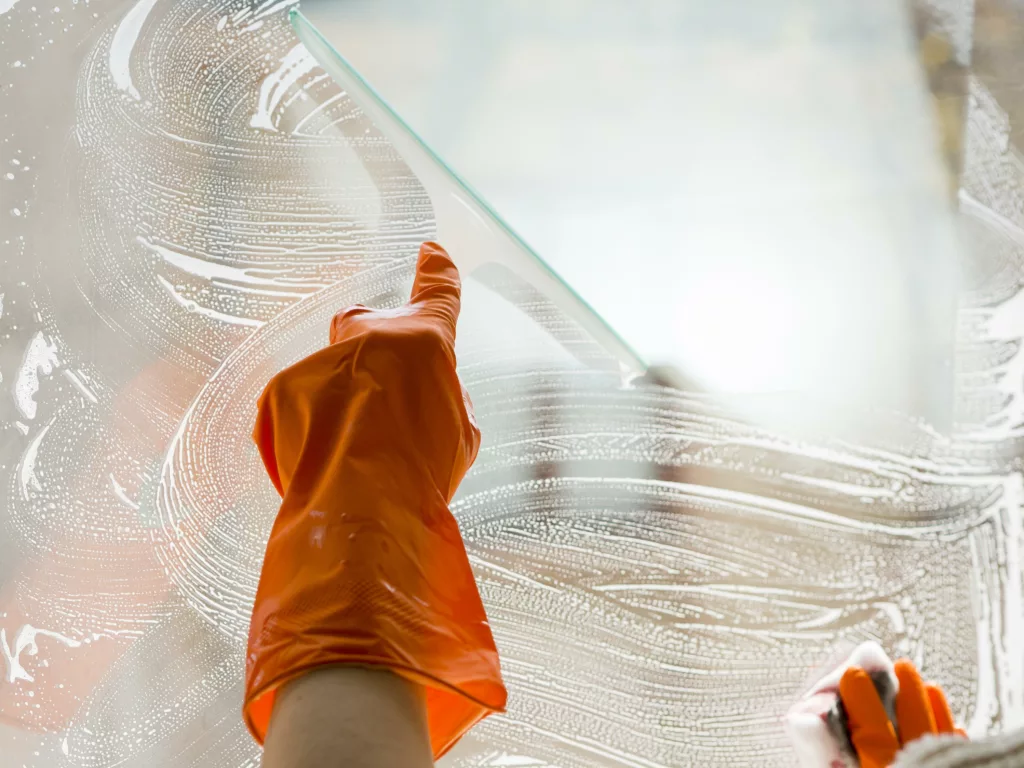
This is the most important stage where mistakes occur most frequently. Guide the squeegee in a smooth, uninterrupted motion from top to bottom, at approximately a 45-degree angle to the glass. The angle matters—too flat causes the rubber to skip, too steep leaves water behind.
After each stroke, wipe the rubber blade dry with a clean cloth—a dirty blade only spreads streaks. This is tedious but necessary. Professionals keep a cloth tucked in their belt and automatically wipe the blade after each stroke.
The alternative “S-technique” works well for large panes: guide the squeegee horizontally, starting from the upper corner, in a snake pattern. Requires practice but is faster.
Step 4: Polishing with a dry cloth
Use a dry microfiber cloth to wipe the glass edges and any remaining moisture. Microfiber works electrostatically, attracting dust and moisture residues without leaving fibres.
Pay attention to corners—that’s where most water and dirt accumulates. Also wipe the frame adjacent to the glass, where streaks often remain.
Step 5: Checking in different light
Examine the result in light falling from various angles. Potential streaks are most visible when standing at an angle to the glass, not directly opposite. In the evening, switch on a lamp and direct light at the glass—it will reveal every imperfection.
Window cleaning tools—what actually works?
Squeegee with rubber blade
Professionals can’t imagine window cleaning without a squeegee. It’s the fundamental tool that mechanically removes water instead of spreading it. The rubber’s hardness is crucial—too soft doesn’t collect water effectively and bends under pressure, too hard leaves stripes and can scratch glass.
Choose models with replaceable rubber inserts, as rubber wears out after several months of intensive use. Good rubber should be elastic yet springy—pressed with a finger, it returns to its original shape. Match squeegee width to window size: 25-30 cm for standard windows, 40-45 cm for large glazing.
Microfiber cloths—not all are suitable
Thanks to its fibre structure, microfiber collects dust electrostatically without requiring much chemistry. Fibres are 100 times thinner than human hair and form thousands of micro-hooks capturing dirt.
But beware: not every microfiber suits windows. Avoid soft cloths with loose weave intended for delicate surfaces (e.g., car paint or furniture)—they’re too fluffy and leave fibres on glass. For windows, choose microfiber with dense, compact weave that produces a slight “squeaking” sound when touched. The best have a weight of 300-400 g/m² and a distinctly textured structure.
Microfiber is safe for both glass and delicate lacquered profiles. Wash regularly at up to 60°C without fabric softener—softener clogs fibres and destroys electrostatic properties.
Nylon stockings—grandmother’s method that works
Nylon has slightly abrasive properties, perfect for removing stubborn marks from insects or dried water drops. It doesn’t scratch glass and leaves no fibres, unlike paper towels which are either too rough or too soft—depending on quality.
Unwearable, washed stockings work best—new ones may contain production residues. Roll them into a ball and use for final polishing after the squeegee.
Steam cleaners—when do they work?
Water vapour at 100-150°C dissolves grease without chemicals and has bactericidal properties. In theory it sounds ideal, in practice it requires quickly removing condensed water before it dries into streaks.
Steam cleaners work as a complement to traditional methods, not as their replacement. They’re useful for removing stubborn dirt (nicotine, kitchen grease) before proper cleaning.
One caution: be careful with PVC frames. Directing hot steam directly at the profile for extended periods can cause local deformation or colour fading, especially in film-wrapped windows.
Paper towels—why they’re not worth it?
Paper towels disintegrate upon contact with water, leaving fibres on glass. Even “durable” ones tend to leave fine lint visible in light. They’re also environmentally unfriendly—one thorough window cleaning means half a roll in the bin.
Natural cleaning methods without chemicals
Vinegar and water—universal mixture
Acetic acid excellently dissolves mineral deposits (limescale) and grease. A 1:3 ratio (vinegar:water) suffices for most dirt. For heavily soiled glass, you can increase to 1:2. Vinegar also has antibacterial properties and leaves a characteristic smell that quickly dissipates.
After cleaning, always rinse the frame with clean water—dried vinegar can dull EPDM seals with prolonged contact.
Important note: Vinegar is acidic (pH approximately 2.5-3).
Important note: Vinegar is acidic (pH approximately 2.5-3). Don’t use it on aluminium frames as it can etch anodized and lacquered coatings, causing permanent dull spots. For aluminium, use only neutral detergents with pH 5.0-8.0.
Glycerine—long-term protection
A few drops of pharmaceutical glycerine (available at any pharmacy for a few dollars) added to water creates a microscopic hydrophilic layer that conducts electrostatic charges. The effect? Dust doesn’t adhere to glass and PVC profiles as quickly as usual—windows stay clean even 2-3 times longer.
Glycerine is also an excellent agent for EPDM seal maintenance—it lubricates them, preventing drying and cracking. One product, two applications.
Ratio: 1 teaspoon glycerine per litre of water for cleaning, or a few drops on a cloth for wiping seals.
Dishwasher rinse aid
This is a genuine discovery among household methods, confirmed by professionals. Rinse aid contains non-ionic surfactants and alcohols that accelerate water runoff. Water doesn’t collect in droplets but flows evenly—exactly what we need.
A teaspoon per litre of water suffices. Rinse aid is neutral for all window materials (PVC, aluminium, wood), so you can use it on frames without concern.
Methylated spirits—winter solution
For cleaning in low temperatures (below 5°C), add 200 ml methylated spirits per litre of water. The mixture doesn’t freeze down to approximately -15°C, allowing window cleaning even on frosty days.
Spirits degrease excellently and evaporate quickly without leaving streaks. But requires caution: alcohol can damage EPDM seals with prolonged contact, dissolving their outer layer. After cleaning with spirits, always rinse the frame with clean water and wipe seals with a damp cloth.
When and how to clean windows? Ideal conditions
Weather and time of day—the cleaning “window”
Avoid cleaning in full sun—this particularly affects dark aluminium profiles (anthracite RAL 7016, graphite RAL 7024). Sunlight causes rapid water evaporation before you can remove it. Dark aluminium profiles heat up to 60-70°C, causing water to evaporate within fractions of a second, leaving all impurities behind.
Ideal conditions are a cloudy, rainless day at 10-20°C. Optimal times: morning (8:00-11:00) or late afternoon (16:00-19:00) when sun doesn’t shine directly on windows. Also avoid windy days—wind accelerates drying and deposits dust on freshly cleaned glass.
Professional tip: if you must clean in sunshine, start with windows on the shaded side and move to the sunny side as the sun shifts. Or plan cleaning different house sides at different times of day.
Seasonal maintenance schedule
Spring (March-April): Thorough cleaning after winter. Remove deposits from road salt, sand, and heating soot. This is the most important moment for lubricating hardware and seals—after winter they require regeneration. Check drainage opening permeability in frames (small slots at the bottom profile).
Summer (June-August): Spot cleaning as needed. Bird droppings and crushed insects contain organic acids (uric acid, fatty acids) that can damage lacquer and glass—remove them as quickly as possible, ideally within 24-48 hours.
Autumn (September-November): Winter preparation. Adjust hardware pressure to winter mode (greater pressure = better sealing). Maintain seals with glycerine or silicone grease—this prevents freezing. Remove leaves and debris from drainage channels.
Winter (December-February): Monitoring and ventilation. Avoid thorough cleaning unless you’re certain temperature won’t drop below 5°C for several hours. Regularly wipe condensation from lower glass edges—standing water promotes mould growth on seals and lower frame sections.
Material-specific cleaning—how to clean different frame types?
PVC profiles
PVC (polyvinyl chloride) is an electrical insulator. During dry rubbing—e.g., polishing with a dry cloth—it generates electrostatic charge that attracts dust particles floating in the air. Result: the window gets dirty again literally minutes after cleaning.
Therefore, always add glycerine to cleaning water—it creates a thin conducting layer, eliminating the electrification problem.
Permitted agents:
- Water with mild detergent (washing-up liquid, soft soaps
- PVC cleaning milk without abrasive granules
- Cosmofen 20 for stubborn dirt (adhesive residue, marker, rubber)
Prohibited agents:
- Acetone, solvents, nitro thinners—dissolve the profile’s top layer
- Chlorine-containing agents—can cause yellowing of white profiles
- Cleaning milk with abrasive particles—scratch the surface
- High-concentration alcohol—dulls the surface
GEALAN-acrylcolor® technology—unique property
GEALAN profiles with acrylcolor® coating have a unique feature: they can be polished. It is a layer of acrylic glass (PMMA) with a thickness of 0.5 mm, inseparably fused with the PVC profile during production. It is twice as hard as standard PVC.
Minor scratches from installation or use can be removed with scouring pad (Scotch-Brite type, in white or grey—not green, as it’s too aggressive) moistened with water. Polish with circular motions using light pressure. This is a unique capability unavailable in film-wrapped windows, where every scratch is permanent.
Aluminium profiles
Aluminium is an amphoteric metal—it reacts with both acids and bases. Protection comes from a thin aluminium oxide layer (anodized) or powder coating. Damaging this layer exposes raw metal that corrodes quickly.
The safe pH range for cleaning agents is 5.0-8.0. Beyond this range, you risk permanent coating damage.
The safe pH range for cleaning agents is 5.0-8.0. Beyond this range, you risk permanent coating damage.
Permitted agents:
- Water with neutral soap or washing-up liquid
- Cosmofen 60—industry standard for removing stubborn dirt (adhesive, marker, mounting foam residue)
- Glass cleaners based on alcohol (but not directly on frames!)
Prohibited agents:
- Vinegar, citric acid, and other acids—etch anodized coating
- Ammonia, caustic soda—destroy powder coating
- Solvents (acetone, white spirit)—dissolve powder coating
- Abrasive agents — scratch delicate surfaces
Hardware and seal maintenance—the window’s invisible heroes
Window cleaning isn’t just about glass and frames. Hardware determines sealing and security, seals—thermal and acoustic insulation. Neglected, they shorten window lifespan by half.
Lubricating perimeter hardware
Modern hardware comprises precision mechanisms consisting of dozens of moving elements: locking bars, corner drives, hinges, and mushroom pins. They work under high load with every window opening and closing.
Factory lubrication degrades over time—it dries out, thickens, loses lubricating properties. Dust (particularly construction dust containing silica) mixes with grease, forming abrasive paste. Result: the handle moves stiffly, mechanisms wear faster, failure risk increases.
How often to lubricate? Minimum once annually—ideally in autumn before heating season. With intensive use (frequently opened windows, tilt windows for ventilation)—twice yearly.
What to lubricate with? Window hardware oil, technical petroleum jelly spray, or silicone grease. These agents don’t gum up, don’t attract dust, and maintain properties across wide temperature ranges.
What to avoid? WD-40 as long-term lubrication. Contrary to popular belief, WD-40 is primarily a solvent and penetrating agent—it’s excellent for loosening seized screws but flushes proper grease from mechanisms. You can use it for cleaning hardware, but then must apply proper grease.
Where to lubricate? All moving elements: mushroom pins (those characteristic “mushrooms” visible on the sash perimeter), corner drive gearboxes, hinges (especially at friction points), locking bars.
Pressure adjustment—winter and summer modes
MACO and Winkhaus hardware enables sash-to-frame pressure adjustment. Mushroom pins have eccentric construction—by rotating them, you change distance to the striker plate and thus pressure force.
Winter mode: Maximum pressure, best sealing. Set mushroom pins so their convex side faces the seal.
Summer mode: Lower pressure, reduced seal load. Set mushroom pins with convex side away from seal.
Seasonal adjustment extends seal and mechanism lifespan. Constant maximum pressure year-round causes permanent seal deformation—after several years they lose elasticity and don’t ensure sealing even at maximum pressure.
Read more: Adjusting your windows for winter and summer: The complete DIY guide [2026]
EPDM seal maintenance
Seals in GEALAN, Yawal, and Aliplast systems are made from EPDM (ethylene propylene diene monomer)—material resistant to ageing, UV, and extreme temperatures (-40°C to +120°C). But even EPDM requires maintenance.
How often? 1-2 times annually—in spring after winter and autumn before winter.
What to maintain with? Silicone grease, technical petroleum jelly, or pharmaceutical glycerine. All these agents lubricate rubber, maintaining its elasticity.
How to apply? Apply a small amount to a soft cloth and wipe the seal around the entire window perimeter. Don’t apply directly from tube—excess drips and soils.
Maintenance objectives:
- Preventing freezing in winter (freezing moisture “glues” seal to profile—opening window can tear it)
- Maintaining elasticity guaranteeing sealing
- Protection against drying and cracking
Post-construction window cleaning—how to remove cement without scratching?
This is the riskiest moment in a window’s lifecycle and the most common cause of manufacturer-rejected complaints. Cement, mortar, mounting foam—all these contaminants require special approach.
Safe cement removal procedure
Cement contains calcium hydroxide, which is strongly alkaline (pH above 12). Dried cement not only mechanically bonds with glass but can chemically etch its surface, causing permanent dulling. On aluminium profiles, alkalis destroy anodizing and lacquer.
- Never dry! Thoroughly moisten contamination with water and detergent for 10-15 minutes to soften cement bonds. Dry scraping guarantees scratches.
- Specialist chemistry: Use products dedicated to cement removal.
- Household alternative: Vinegar solution with water in 2:1 ratio. But caution: apply only to glass, not aluminium frames! And only briefly (5-10 minutes), then rinse thoroughly.
- Contact time: Leave the agent for 5-10 minutes to work chemically. Don’t rush.
- Gentle tools: Plastic spatula, wooden scraper, sponge. No metal scrapers—neither on glass nor profiles.
- Rinsing: After cement removal, thoroughly rinse entire surface with clean water to remove chemical residues.
Mounting foam and adhesive
Fresh foam: Remove as quickly as possible before it hardens. Use PUR foam cleaning wipes or dedicated agent. Fresh foam comes off easily.
Hardened foam: Is chemically neutral and very difficult to remove—no safe solvents work on it. Only method: gentle mechanical removal. Cut excess with sharp knife (careful with frame!), and scrape residue with fingernail or plastic spatula. Special pastes exist for softening hardened foam, but require longer contact time and caution.
Adhesive residue from masking tape: Acrylic adhesive from masking tapes cross-links under sunlight—the longer tape remains, the harder to remove. Remove adhesive residue with Cosmofen 20 (PVC) or 60 (Aluminium) or soak with warm soapy water for 15-20 minutes.
Frequently asked questions about window cleaning
What’s best for cleaning windows without streaks?
The combination of rubber-bladed squeegee and microfiber for polishing gives optimal results. Add dishwasher rinse aid or glycerine to the solution—they accelerate water runoff and prevent surface electrification.
Is tap water suitable for window cleaning?
Hard water (above 200 mg CaCO₃/l) contains minerals that leave whitish streaks after drying. With hard water, you have three options: use boiled water (minerals precipitate during boiling), demineralized water (available at hardware stores), or add a little vinegar to water (acid dissolves carbonates). The difference is enormous.
How to clean windows in winter without freezing?
Add 200 ml methylated spirits per litre of water—the mixture doesn’t freeze down to approximately -15°C. Alternatives are ready-made winter fluids for car windows (but choose those without fragrances and dyes). After cleaning, always wipe the frame with clean, damp cloth to protect seals from alcohol effects.
Are window cleaning robots worth their price?
Robots (e.g., Hobot, Ecovacs) work well with many windows, regular cleaning, and difficult access (e.g., high glazing). For an average house with 10-15 windows, traditional methods are faster (robot cleans one window in 10-15 minutes, manually takes 2-3 minutes) and significantly cheaper.
How long do PVC windows last with proper maintenance?
High-quality PVC windows from the GEALAN S8000 or S9000 systems will last 25-40 years with standard maintenance: cleaning the frames 2-4 times a year, lubricating the fittings and seals twice a year, and seasonal adjustment of the pressure. Seals should be replaced every 10-15 years, while fittings may need to be adjusted or replaced after 20-25 years. The profiles themselves are practically wear-free.
How to maintain aluminium windows?
Aluminum windows are virtually maintenance-free — they do not require painting, impregnation, or other labor-intensive treatments. Simply wash with a neutral detergent and lubricate the fittings annually. When used correctly, they will last 30-50 years without losing their parameters.
Can I use vinegar to clean aluminium frames?
Definitely not. Vinegar (acetic acid) has pH approximately 2.5-3, while the safe range for aluminium is 5.0-8.0. Acid can etch anodizing and lacquer coating, leaving permanent dull spots. For aluminium, use exclusively neutral agents.
Summary—key takeaways
Streak-free window cleaning is about proper technique and material understanding, not expensive products. Remember these fundamental principles:
Technique more important than products. Squeegee + microfiber give better results than the most expensive liquid rubbed in with paper towel. Mechanical water removal is essential.
Regular maintenance better than thorough cleaning. Regular maintenance 2-4 times yearly means less work than battling years of dirt and damaged seals.
Material determines method. PVC requires antistatics (glycerine) and tolerates most detergents. Aluminium requires neutral pH (5.0-8.0)—no vinegar, no ammonia.
Hardware and seals determine durability. Annual lubrication extends mechanism lifespan by 30-50%. Neglected hardware means failure after 10 years instead of 25.
Cleaning conditions matter. Cloudy day, temperature 10-20°C, no wind. Cleaning in full sun guarantees streaks.