

Threshold-Free Terrace Doors and Barrier-Free Entrances for Older Adults
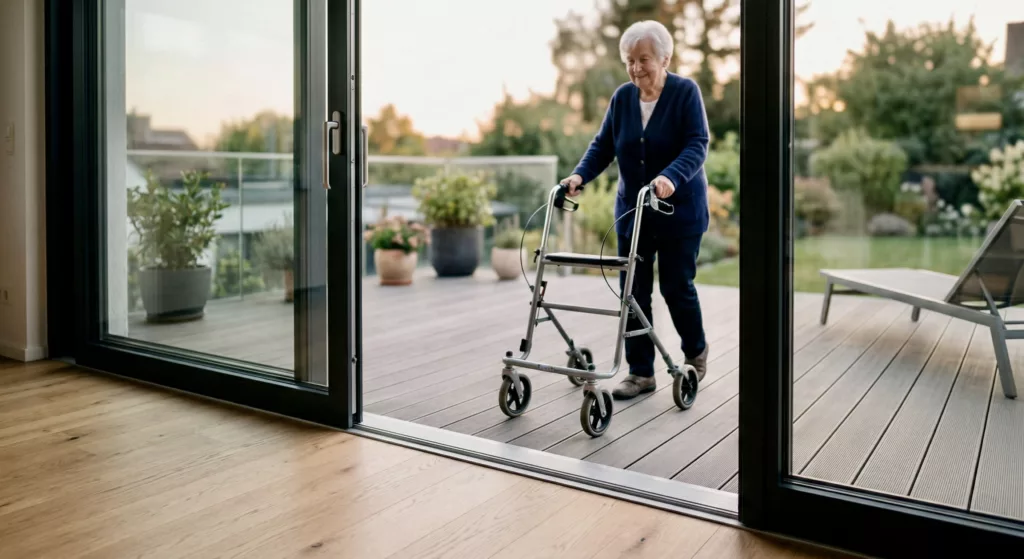
Do you have a 5–7 cm threshold at the exit to your terrace? For a fully able-bodied person, this is a detail that they don't even notice. For a senior citizen with reduced joint flexibility, balance disorders, or who walks with a walker, it is a real obstacle that can turn into a serious hazard. Falling on a patio door threshold is one of the most common scenarios for accidents in the home among people over 65, and its consequences – a broken hip, hospitalization, loss of independence – can be irreversible. The trend of “aging in place,” i.e., aging in one's own home instead of in a care facility, requires a completely new approach to the design of terrace joinery. The key to safety and comfort is the elimination of architectural barriers, and the most effective technical solution is HST lift and slide doors with a threshold flush with the floor.
Why even a small door threshold poses a real fall risk for seniors
A height of 5 to 7 centimetres may seem trivial, but in the biomechanics of an older adult’s movement, it represents a serious hazard. Seniors with limited hip joint mobility often cannot lift their feet as high as younger people do; instead, they tend to shuffle or slide their feet along the floor. Catching a toe on a raised threshold is all it takes to lose balance and fall.
How a small threshold becomes a barrier for walkers, crutches, and wheelchairs
A wheeled walker or rollator frame, the most widely used mobility aid among seniors, requires a flat, step-free surface. Every threshold demands that the user lift the frame over it, which takes both strength and coordination that may be in short supply. A wheelchair cannot cross a threshold higher than 20 mm without outside assistance. Even a two-centimetre edge creates resistance when rolling over it and forces a sudden jolt that can destabilise the user.
Environmental factors compound the risk: a wet threshold after rain becomes slippery, and in dim evening lighting it can be virtually invisible. Seniors with reduced visual acuity are especially vulnerable to tripping at the terrace transition point, particularly when the threshold does not contrast visually with the surrounding floor surface.
What is a zero-threshold HST door, and when do you actually need one?
Before deciding which threshold type to specify, it is worth understanding the options that lift-and-slide door systems offer and how the different configurations differ from one another.
Standard HST threshold (48 mm) vs. low-threshold (up to 20 mm) vs. zero threshold
A standard lift-and-slide (HST) threshold sits 48 to 50 mm above the finished floor level. It is a structural element that carries the running rails and weatherseals. You cannot simply remove it, but you can conceal it within the floor build-up.
In a low-threshold configuration, the threshold protrudes no more than 20 mm above the finished floor. This solution meets the requirements set out in EN 17210 and comparable national accessibility standards for buildings intended to serve people with limited mobility. For many seniors, this level is entirely sufficient: it presents no barrier to someone walking independently or pushing a pram.
A zero threshold is a configuration in which the top edge of the running rail projects only approximately 5 mm above the finished floor level. In practice, this creates an almost imperceptible transition. Achieving it requires precise planning of every floor layer before the screed is poured: the running rail, standing just a few millimetres proud of the floor, is the only element that breaks the plane of the surface.
When is a 20 mm threshold sufficient, and when is it worth investing in zero threshold?
A 20 mm threshold works well when the senior moves independently or with minimal support (a walking stick or forearm crutch), and when the terrace transition is not the main circulation route through the home. A zero threshold is recommended in three situations: when a resident permanently uses a wheelchair; when the home is being planned for decades ahead with changing needs in mind; and when full compliance with universal design principles (EN 17210) is a priority, as these standards may in future become a condition for certain building certifications.
HST lift-and-slide doors as the ideal terrace solution for seniors
Not all sliding door systems are equal. Popular and lower-cost tilt-and-slide systems (PSK) do not offer the technical possibility of a zero threshold at all: their threshold is as high as a standard window frame. A flush or near-flush threshold is exclusively the domain of lift-and-slide (HST) systems.
Why the HST mechanism allows effortless operation even with limited grip strength
The HST mechanism works on a simple but highly effective principle: when the handle is turned, the sash lifts 5 to 8 mm off the weatherseals and transfers its weight onto precision rolling carriages. At that point there is zero friction and the sash rolls on bearings alone.
In practice, this means that even a sash weighing 200 to 250 kg (440 to 550 lb) can be moved with a single finger. The Hautau ATRIUM HS hardware used in BWS systems is rated to carry sash weights of 330 to 440 kg, so at a typical sash weight the hardware operates at roughly half its rated capacity. That built-in reserve guarantees smooth operation for decades and is especially important for seniors whose grip strength decreases progressively with age.
When does an electric HST drive make sense?
For someone living with advanced rheumatic conditions, or for a full-time wheelchair user, even the light effort of sliding a panel can be a challenge. In these situations, an electric HST drive integrated into the Hautau automation system provides the answer. The drive handles sashes up to 440 kg and allows control via a handheld remote, a wall-mounted keypad, or a smartphone app.
Important: power supply cables and conduit runs for the HST drive must be planned and installed before the floor screed is poured. Retrofitting the installation later is possible but expensive and technically complex.
HST in PVC or aluminium for a senior-friendly home?
PVC HST doors built on GEALAN S9000 profiles offer an excellent balance of performance and value. The system achieves a thermal transmittance value of Uw from 0.71 W/(m²K), accommodates sash weights up to 400 kg, and supports glazed areas of up to 14 m². It is the right choice for homeowners who need a proven solution in standard dimensions.
Aluminium systems open up far greater design possibilities. The Yawal DP180 Primeview, the flagship HST system in the BWS portfolio, achieves Uw from 0.7 W/(m²K) with 47 dB acoustic insulation, sash dimensions up to 3,300 × 3,300 mm, and a sash weight capacity of 600 kg in the motorised version. Critically, this system features an integrated linear drainage channel and allows the threshold to be set completely flush with the floor. Its narrow central mullion of just 47 mm barely interrupts the panoramic view.
Aliplast Ultraglide offers a modular platform in five variants, from the economical UG to the design-focused Monorail, including a 90-degree corner configuration without a central post and a low threshold flush with the floor. The system handles sashes up to 3,200 × 3,300 mm and 440 kg.
Yawal Moreview is the third option in the BWS portfolio: a visionary sliding glass wall system spanning up to 18 metres wide, with the narrowest mullion on the market at 27 mm and Uw from 0.7 W/(m²K). It is designed for prestige residences where a barrier-free terrace transition combines with the effect of an invisible wall.
For a detailed comparison of PVC and aluminium HST systems, see our dedicated article: HST vs. PSK Sliding Doors: Key Differences and How to Choose the Right System for Your Terrace.
The front door threshold: the second barrier people often overlook
A barrier-free home means more than just the terrace. If you eliminate the threshold at the garden exit but leave a high step at the front door, you simply move the problem to the front of the building. A senior who safely accesses the terrace may still trip when re-entering from the street, and a fall onto a hard paved surface outside is even more dangerous than one on a timber deck.
How the front door threshold differs from an HST threshold
Front entrance doors work differently from sliding doors: they open on hinges rather than rolling on rails. The threshold here serves primarily as a weatherseal (a barrier against rainwater, wind, and cold) and as a structural closing element at the base of the frame. A standard external door threshold is typically 15 to 25 mm high, significantly less than on an HST system, but it can still be an obstacle for a senior using a rollator frame or for a wheelchair user.
The key difference is that because there is no running rail at a hinged entrance door, it is technically easier to achieve a low threshold profile. The challenge lies in maintaining weathertightness: the threshold must effectively shed water and block drafts while being as low as possible.
What to consider when specifying the front door threshold in a barrier-free home
The ground in front of the door should slope away from the threshold at a gradient of 1.5 to 2 percent so that rainwater drains away rather than pooling against the door. A canopy or covered porch over the entrance protects the threshold zone from direct rain, extends the life of the seals, and makes entry more comfortable.
If there is a step or flight of steps at the entrance, the solution is a ramp with a gradient not exceeding 1 in 20 (5 percent) per EN 17210, with handrails on both sides. Electric locking systems, operable by remote control, PIN code, or biometric reader, also make a significant difference for seniors whose finger dexterity or hand strength is reduced. BWS systems can be factory-prepared for smart home integration, allowing the front door to be controlled from a smartphone or wall panel.
The full range of aluminium and PVC entrance doors, complete with technical specifications and personalisation options, is available in the Doors section of the BWS Technika Budowlana website.
Six design requirements for a truly barrier-free terrace transition
1. Floor build-up depth and sub-base construction under a zero threshold
The standard HST threshold sits 48 to 50 mm high. To conceal it within the floor, the sub-base in the opening zone must be set approximately 45 mm below the intended finished floor level. That space is filled with thermally insulating packing blocks made from high-compressive-strength materials such as Purenit or hard-grade XPS insulation board.
Standard expanded polystyrene (EPS) is completely unsuitable here. Under the weight of the threshold loaded by the sash (400 to 600 kg), EPS will compress, the threshold will settle, the sash will jam, and air and water infiltration will follow. Correcting this requires dismantling the entire multi-hundred-kilogram assembly.
The decision to specify a zero threshold must be made before the internal screed is poured. Changing your mind after the floor finish is laid is the most costly mistake possible: it means breaking out the floor, constructing a new sub-base, and relaying the entire floor finish.
2. Clear opening width: 90 cm minimum, 120 cm recommended
EN 17210 requires a minimum clear opening width of 90 cm. For optimum comfort, including free manoeuvring of a powered wheelchair and room for a carer alongside, 120 cm or more is recommended. A manoeuvring space of at least 1,500 × 1,500 mm in front of the terrace door allows a wheelchair user to turn around freely.
3. Linear drainage: one omission and rainwater enters the living room
With a zero threshold, rainwater running down a large glass surface flows directly into the zone that is level with the interior floor. Without an effective water barrier, flooding of the room is only a matter of time.
The terrace must be laid with a fall of at least 1 to 2 percent towards a drainage outlet. Per metre of terrace surface, the floor drops 10 to 20 mm. A linear drainage channel, a drainage slot concealed beneath a decorative grate, captures water immediately in front of the threshold and diverts it to the stormwater drainage system or a soakaway. The Yawal DP180 Primeview system incorporates a factory-integrated linear drainage channel built into the threshold itself.
Critically, the drainage must be coordinated with the plumbing designer before the screed is poured. Correcting a terrace that has been laid with the wrong fall typically costs between 3.500 to 4.700 Euros (breaking out the surface, relaying all layers, and relaying the tile finish).
4. Warm-edge installation: eliminating thermal bridging at the threshold
The threshold zone is the most common point of heat loss in large-format glazed openings. Warm-edge installation of an HST door means a three-layer seal: a vapour-control membrane on the inside face, low-expansion polyurethane foam in the cavity, and a vapour-permeable breather tape on the outside. Beneath the threshold: thermally insulating packing blocks with a conductivity value of approximately λ = 0.25 W/mK, together with EPDM damp-proof flashing bridging the threshold and the structural base.
Without these measures, a cold floor zone will develop at the door in winter, condensation will form, and mould will follow, even when underfloor heating is installed.
5. Structural lintel and steel beam: essential for openings wider than 3 metres
At spans exceeding 3 metres, a standard reinforced concrete lintel is not adequate. You need a purpose-designed steel beam or universal beam with a minimum bearing of 25 to 30 cm on the masonry at each side. If the lintel deflects under the load of the floor structure above, the sash will jam in its running channel; even one millimetre of deflection is enough to prevent a 400 kg sash from sliding.
6. Installation clearances: aluminium expands with temperature
The structural opening must be 15 to 20 mm larger than the HST frame dimension on every side. Aluminium expands in heat: dark-coloured profiles on a south-facing elevation can extend by several millimetres. Without adequate clearance, the frame will become wedged in the opening. As a practical example: if you order a 3,000 mm wide door, the structural opening should be designed at 3,040 mm (3,000 + 2 × 20 mm), with a further 20 mm added at the head.
Accessibility standards and building regulations: applying them to a private home
What EN 17210 and energy efficiency regulations say about terrace doors
EN 17210 describes the accessibility of the built environment and recommends a minimum clear passage width of 90 cm, a maximum level difference of 20 mm on accessible routes, and a manoeuvring space of 1,500 × 1,500 mm in front of entrances. National building energy codes, such as the German GEG, Part L in the UK, or IECC in the United States, also set maximum thermal transmittance values for windows and glazed doors. The HST systems in the BWS range achieve Uw values from 0.7 W/(m²K), comfortably exceeding the requirements of all major energy codes.
Formal accessibility legislation typically applies primarily to public and commercial buildings. However, the design standards it sets can and should be applied to private homes, particularly when planning a residence that is intended to serve its occupants for several decades.
Funding and incentives: when barrier-free terrace door upgrades qualify for financial support
In many countries, financial assistance is available for barrier-removal works and energy-efficient renovations. In the United States, home modification grants and low-interest loans are available through programmes such as the USDA Section 504 Home Repair Program, local Area Agencies on Aging, and various state-level funding schemes. Many US states also offer property tax exemptions for accessibility modifications. Individual homeowners should check with their local housing authority or Area Agency on Aging for current eligibility criteria and grant amounts.
For energy-efficient glazing upgrades, the federal Inflation Reduction Act (IRA) Energy Efficient Home Improvement Credit (25C) may apply where the replacement windows or doors meet the relevant ENERGY STAR certification criteria. The thermal performance of modern HST systems, with Uw values from 0.7 W/(m²K), typically qualifies for such programmes.
Important: in most grant and tax credit programmes, work must not begin before the application has been formally approved, as starting early usually disqualifies the claim entirely. Always verify current eligibility criteria and application procedures with the relevant programme administrator before proceeding.
Barrier-free living in practice: different users, different needs
Every user of a threshold-free terrace opening has different priorities. Understanding those differences helps you specify the right HST configuration.
Seniors living independently
Priority: minimising fall risk. Specify a low threshold (up to 20 mm) or a zero threshold, use strong visual contrast at the transition edge (for example, a dark threshold profile against a light floor), and ensure the terrace area is well lit. An HST system with effortless gliding gives seniors the confidence of independence: they can open and close the door without straining or jerking.
Families and carers
Priority: the safety of the person in their care and making sensible use of the available budget. Key questions to address early: is there a funding programme we can access? Is it worth investing in motorised operation now rather than retrofitting it later? A practical approach is to phase the works: start with the terrace door (the most common barrier), then address the bathroom and other areas as resources allow.
People with mobility impairments
Priority: full autonomy. Specify a zero threshold (less than 5 mm) or ideally a surface flush with the finished floor, a clear opening width of at least 90 cm (optimally 120 cm), and an electric drive operable from the wheelchair, whether by remote control, mobile app, or voice command through a smart home system.
Architects and specifiers
Priority: avoiding design errors at the interfaces between trades (flooring, drainage, joinery). Architects need hard data: sub-base depth of 45 mm below finished floor level, installation clearances of 15 to 20 mm, terrace fall of 1 to 2 percent, lintel and load requirements. A detailed technical design guide for professionals is available in our article: Zero-Threshold HST Doors: 8 Things Architects Must Specify at Design Stage.
Developers and project builders
Priority: scalability, certification, and market value. Threshold-free terrace access is becoming a standard expectation in the upper residential market. For developers building schemes with an aging-in-place strategy in mind, it is a differentiating feature that increases the appeal and value of the property to the growing 50+ buyer demographic.
Universal design: why zero-threshold terrace doors benefit everyone
It is worth remembering that barrier-free design benefits all occupants, not just seniors. Parents pushing a buggy, someone temporarily on crutches after an injury, or simply a person carrying a garden table out to the terrace: everyone benefits from a level transition.
Children, buggies, and temporary injuries: designing for the long term
Universal design is a planning philosophy based on the recognition that residents’ needs change throughout their lives. A couple in their thirties building a home today plans the space to accommodate a pram. Twenty years later, the same doors will make life easier for ageing parents. Fifteen years after that, the original occupants themselves will appreciate the accessibility they built in from the start. A threshold-free terrace transition is an investment that matures alongside the people who live in the home.
Property value and resale appeal of an accessible home
A home designed without barriers is easier to sell on the second-hand market. In many international real estate markets, accessibility features are increasingly becoming a standard part of property listings and measurably increase sale values. With ageing demographics and growing awareness of universal design principles, accessible homes are already gaining a competitive advantage that will only increase in the years ahead.
HST automation and smart home integration for terrace doors
What needs to be planned at design stage
An HST electric drive requires a 230 V power supply run to the installation opening. The cable should be routed within the wall insulation layer and terminate at a suitably positioned back box, typically in the head zone or in one of the side mullions. A separate control cable to the building automation hub (KNX, Loxone, or a comparable system) should also be planned at this stage.
The Hautau automation system used in BWS products handles sashes up to 440 kg and supports programmable scenarios: automatic closing triggered by a rain sensor, a wind-speed lock to prevent opening in high winds, and a scheduled ventilation routine at set times of day. For a wheelchair user, this means the terrace door opens at the press of a button, with no need to stand, exert force, or ask for help.
If you are not planning automation right now but want to keep the option open for the future, it is sufficient to install conduit sleeves in the walls during construction. The cost is minimal and the benefit is substantial: you will avoid the need to cut channels in finished walls years down the line.
The most common mistakes in barrier-free terrace door design
Based on BWS Technika Budowlana’s experience, these are the planning errors we encounter most frequently:
- Deciding on a zero threshold too late, after the screed has already been poured and the floor build-up depth is fixed. The only remedy is the costly work of breaking out the floor.
- Omitting linear drainage and adequate terrace falls, leading to flooding of the interior during heavy rain, damage to the floor finish, and mould growth.
- Designing the opening too narrow to meet today’s needs, without considering that the occupant may need wheelchair access in 10 to 15 years’ time.
- Using standard EPS insulation instead of high-compressive-strength packing blocks under the threshold. EPS compresses under 400 kg, the threshold settles, and the sash jams.
- Failing to plan the power supply for an HST drive during construction. Running cables after the building is complete is an unnecessary extra cost and complication.
- Omitting a steel beam at spans greater than 3 metres. The lintel deflects under load, and the sash jams in the running channel.
How to choose barrier-free terrace doors: a practical checklist
Before you commit to a purchase, work through the following key points:
- Verify the threshold height. Ask about the low-threshold variant (up to 20 mm) or the zero-threshold configuration. In BWS systems, the standard HST threshold (48 mm) can be concealed within the floor build-up, leaving only approximately 5 mm of running rail projecting above the finished surface.
- Compare PVC and aluminium HST systems in terms of required dimensions and budget. PVC (GEALAN S9000 HST, Uw from 0.71 W/(m²K)) is well suited to standard-size openings. Aluminium (Yawal DP180 Primeview, Uw from 0.7 W/(m²K), sash capacity up to 600 kg) offers complete design freedom for large glazed openings and a zero threshold with integrated linear drainage.
- Confirm that the designer has specified a floor build-up depth of 45 mm below finished floor level, linear drainage with a 1 to 2 percent fall, and installation clearances of 15 to 20 mm.
- Ask about electric drive and smart home integration, especially if the home is being planned for a 20 to 30-year occupancy horizon.
- Explore available funding. Depending on your location, grants, low-interest loans, or tax credits may be available for accessibility modifications and energy-efficient window and door upgrades. Contact your local housing authority or energy efficiency programme administrator for current eligibility requirements.
- Specify warm-edge installation. A three-layer air and vapour seal at the installation zone eliminates thermal bridging and ensures that the declared Uw values are maintained in practice over the life of the installation.
- Do not overlook the front door. A low threshold with a thermal isolator, an automatic locking system, and ground graded away from the threshold together complete the truly barrier-free home. An aluminium entrance door (for example, Aliplast Imperial 800 with Ud from 1.05 W/(m²K) and RC3 burglar resistance) or a PVC door (GEALAN S8000/S9000) eliminates the barrier at the main entrance as effectively as at the terrace.