

Wall-mounted or freestanding pergola – how to choose the right terrace canopy for your home
Planning a terrace canopy seems straightforward at first glance. In reality, it demands simultaneous consideration of a dozen technical variables. The choice between a wall-mounted and a freestanding pergola is not simply a matter of which option looks better on an architect's render. It is a decision about how structural loads are transferred to the ground and walls, about the risk of thermal bridging in the building envelope, about the legal implications under local planning regulations, and ultimately about real, everyday comfort on your terrace for the next 20 to 30 years. Misjudging the load-bearing capacity of a wall, ignoring setback requirements from a property boundary, or overlooking the problem of snow sliding off the main roof – any one of these mistakes can cost thousands of dollars and months of frustration.
Wall-mounted vs. freestanding pergola – structural mechanics explained
Although modern aluminium pergolas with motorised bioclimatic louvres look virtually identical regardless of how they are installed, the way they work structurally is fundamentally different. Understanding this distinction will help you make a well-informed decision rather than one based purely on aesthetics.
Freestanding pergola – an independent structural system
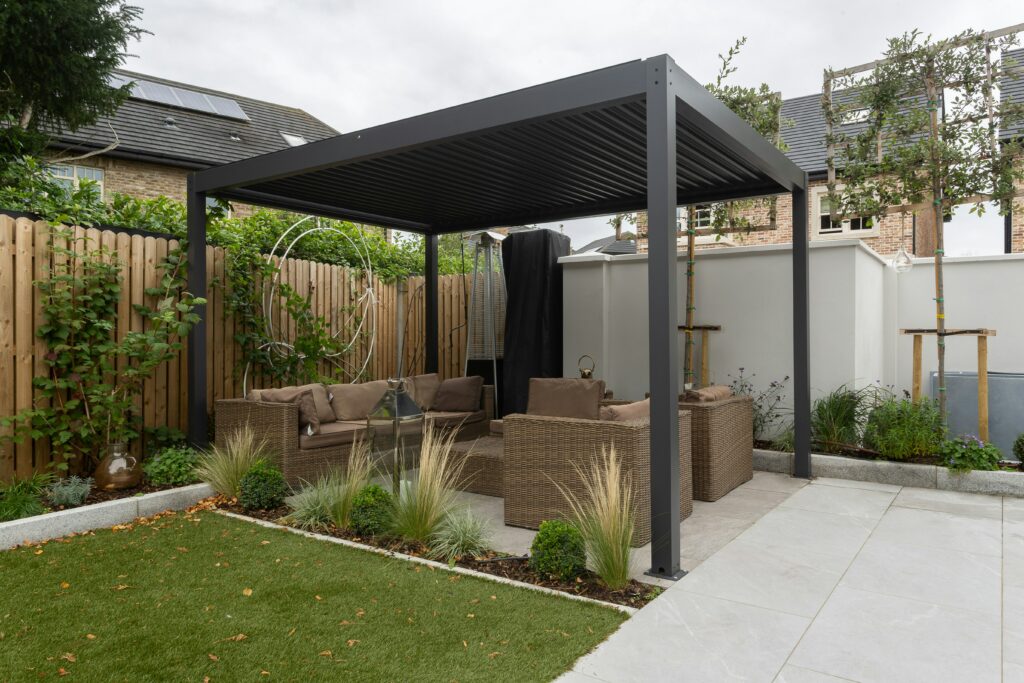
A freestanding structure is a fully autonomous, self-supporting three-dimensional frame. It rests on a minimum of four load-bearing columns that absorb 100% of the loads from the roof frame – both the vertical compressive forces (the dead weight of the aluminium profiles, accumulated snow and rainwater) and the dynamic horizontal forces generated by wind pressure and suction. All gravitational forces are transferred vertically downward, directly into the foundations set into the ground below the local frost depth.
Frost depth varies considerably by region and climate zone – from around 60 cm in mild coastal areas to over 120 cm in colder continental climates. Placing a foundation above this threshold leads to progressive racking of the entire frame as a result of frost heave. Water freezing in the soil pores expands by nearly 9%, lifting the upper soil layers with enough force to jam the rotational mechanisms of the roof louvres.
Wall-mounted pergola – a hybrid system with shared loads
A wall-mounted pergola uses only two front load-bearing columns. Its rear edge – a substantial aluminium profile known as the wall-fixing rail – is permanently anchored into the structural fabric of the building. This arrangement means loads are shared: the front columns act as supports, while the building wall absorbs both half of the vertical gravity load and – far more critically – the pull-out, shear and bending forces caused by wind suction.
The wall must therefore act as a full structural element for the pergola roof. In practice, this means absorbing forces in the range of 250–400 kg per linear metre of fixing rail, depending on the wind load zone and snow load level. A thorough structural assessment of the wall condition at the pre-installation survey stage is therefore absolutely essential and non-negotiable.
Installing a wall-mounted pergola – why drilling into the facade is a serious engineering task
Installing a wall-mounted pergola involves precisely drilling holes in the facade, perfectly levelling the fixing rail along the wall, and executing flawless sheet-metal flashings and seals at the junction between the aluminium frame and the exterior render. Each of these stages carries specific risks that most online guides completely ignore.
Issue 1 – the material of the load-bearing wall
The choice of fixing system is determined by the base material from which the wall is built. For reinforced concrete or solid clay brick, engineers permit the use of high-strength mechanical expansion anchors. The situation becomes considerably more complex with modern hollow-core masonry materials – perforated clay blocks (e.g. Wienerberger Porotherm), aerated autoclaved concrete (e.g. Ytong) or hollow calcium silicate blocks. Using standard mechanical fixings in such walls is a fundamental construction error that leads to the crushing of the thin internal webs of the masonry unit.
The correct approach requires chemical injection anchors based on two-component vinyl ester or epoxy resin. Installation involves drilling a hole to a precisely calculated diameter (typically 2–4 mm larger than the threaded rod), thoroughly removing all drill dust, and then injecting the resin through a dedicated mesh sleeve. The sleeve prevents the resin from running uncontrolled into the hollow voids and allows the formation of a hardened resin plug that locks mechanically between the internal webs of the block.
Issue 2 – thermal bridging through external wall insulation
This issue is treated with alarming superficiality by many installers – yet it represents the most serious technical risk in wall-mounted pergola installation. Most modern buildings are insulated with an External Wall Insulation (EWI) system, also known as ETICS, consisting of a thick layer of expanded polystyrene (EPS) or mineral wool. Fixing a heavy pergola roof frame directly through this insulation using standard steel rods is an extremely destructive process.
First, the clamping pressure of the fixing rail mechanically compresses the insulation, destroying the render reinforcement layer and opening a path for water ingress. Second, a steel rod piercing the insulation all the way to the warm masonry creates a severe point thermal bridge. This leads to local chilling of the wall section on the interior room surface, migration of the dew point to the inner face of the wall, and ultimately to persistent moisture damage and mould growth.
To prevent this, thermally broken fixing systems are used. The system employs a galvanised steel anchor rod fitted with a precisely formed cone of glass-fibre reinforced polymer. The cone interrupts the heat conduction path, reducing the point thermal bridge value to close to the reference value of 0.00 W/K.
Issue 3 – the developer’s facade warranty on new-build properties
New-build properties typically carry strict warranty conditions. Any penetration of the EWI layer by parties who are not authorised by the original insulation contractor normally results in the immediate and permanent forfeiture of the facade warranty and statutory guarantee.
When a wall-mounted pergola is the right choice
Despite the technical demands described above, direct wall attachment remains the most popular choice for terrace canopies – and in specific scenarios it is clearly the optimal solution.
Small terrace – making the most of every square meter
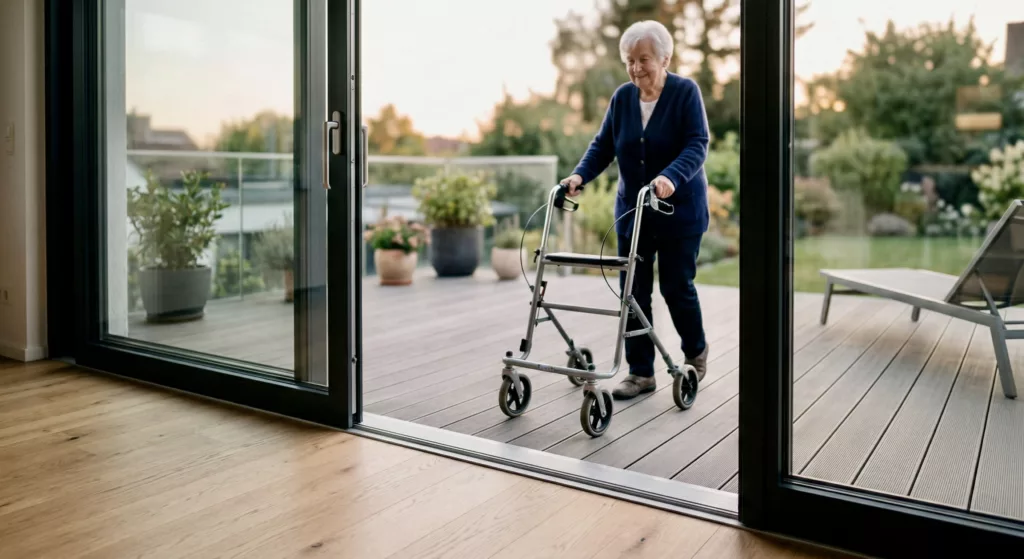
On plots with limited outdoor space, particularly in terraced housing or semi-detached homes, terraces typically measure between 10–15 m². A freestanding pergola requiring four substantial columns (15×15 cm cross-section) would severely disrupt movement around the terrace. A wall-mounted pergola, by eliminating the two rear columns, allows unobstructed passage through terrace doors – including wide sliding door systems such as lift-and-slide (HS) configurations. The absence of vertical barriers at the facade makes the terrace feel significantly more spacious and preserves the panoramic view from the living room.
Thermal protection for glazed south-facing walls
The close integration of an aluminium canopy with a south- or south-west-facing glazed wall has a crucial climatic function. During summer, motorised bioclimatic louvres block aggressive solar radiation before it reaches the glazing, preventing the greenhouse effect inside the living space. This translates into measurable air-conditioning savings – an advantage that no freestanding pergola positioned several feet away in the garden can deliver.
Architectural harmony with the building
A canopy anchored firmly to the wall stops looking like a standalone garden structure and becomes a natural extension of the living room – a summer dining space that blurs the boundary between inside and outside. In the architecture of modern flat-roof homes, an aluminium pergola completes the geometric composition. Powder-coated finishes across a full RAL palette of over 213 colours allow a perfect colour match with the building’s window joinery.
When a freestanding pergola is the better solution
Freestanding canopies offer unrestricted engineering freedom and effectively eliminate most of the structural risks associated with the complex building physics of a wall connection. They are the preferred choice for homeowners who value long-term safety, spatial flexibility and peace of mind.
Complete independence from the facade and insulation
The single most important engineering argument in favour of a freestanding pergola is its complete indifference to the condition and thickness of the facade insulation. Attempting to anchor a heavy aluminium roof structure – loaded in winter with accumulations of wet snow – to a wall through 20 cm of graphite EPS insulation is an extreme structural risk. Both EPS and mineral wool offer virtually zero resistance to compressive and shear stresses.
A freestanding pergola can be positioned with just a few inches of clearance from the facade plane – a so-called self-supporting structure flush with the wall. From the perspective of someone using the terrace, it looks and functions identically to a wall-mounted version: it shades the living room and provides shelter immediately upon stepping outside. However, it rests on its own four columns. It creates no thermal bridges, does not void the facade warranty, and does not cause cracking in silicone render due to the differential thermal expansion between aluminium and masonry.
Design freedom on larger plots
On spacious properties, a freestanding pergola becomes a landscaping tool. The structure is not constrained by the architecture of the main building – it allows the creation of independent relaxation zones by the pool, around an outdoor kitchen, or at the far end of the garden. Freedom from the facade wall also means total flexibility in setting the roof frame height, without restrictions from roof overhangs, first-floor balconies or existing exterior roller shutters.
Freestanding frames also feature integrated, ready-to-use guide channels for Screen ZIP side roller blinds and full-perimeter glazing on all four sides. In wall-mounted configurations, integrating side screens on the wall side is logistically more complex, requiring gap-covering trims and artificial standoffs from the rough render surface.
Legal security in terraced housing and residential communities
Buyers of terraced homes often incorrectly assume that the external wall of their unit belongs exclusively to them. Under condominium and shared-ownership property law, the facade and external insulation system form part of the common structure, subject to management by the homeowners’ association (HOA) or equivalent body. Installing a wall-mounted pergola that requires physically piercing the facade constitutes an intervention in the common structure – it requires a formal HOA resolution and a rigorous technical plan. Without approval, the work constitutes an unlawful alteration under civil law.
A freestanding pergola installed on a private garden plot does not touch the building fabric at any point. Its installation typically requires only notification to the building manager, bypassing time-consuming neighbour consultations entirely and minimising the risk of disputes.
Snow and wind loads – standards and design requirements
Every aluminium structure must withstand the effects of atmospheric loading. Our pergolas are designed to handle snow loads of up to 200 kg/m² and wind speeds of up to 110 km/h. Aluminium profiles with a minimum wall thickness of 3 mm, finished with powder coating compliant with EN 12206-1, ensure long-term durability with no maintenance requirements.
Asymmetric loading on wall-mounted pergolas
In accordance with EN 1991-1-3 (the European standard governing snow load calculations), the accumulation of snow cover is directly related to the geometry of adjacent structures. For a freestanding structure at some distance from the main roof, snow falls on the louvres relatively uniformly (standard roof shape coefficient μ₁ ≈ 0.8).
The situation becomes significantly more complex for pergolas attached to taller facades beneath a pitched main roof. The pergola roof not only receives normal snowfall but is also subject to two particularly hazardous phenomena: snow sliding from the higher main roof, and wind-driven snow accumulation due to aerodynamic turbulence (the so-called snow pocket effect). Large masses of ice sliding from the house roof strike and come to rest at the rear beam of the pergola, introducing local overloads many times higher than standard design values. This asymmetry demands additional reinforcing cores in the rear beam, heavy-wall aluminium sections and long chemical anchors.
In heavily snow-loaded mountain and upland regions – where ground snow load s_k reaches or exceeds 1.5 kN/m² – structural engineers consistently recommend keeping the outdoor living zone separate from the main building mass and selecting a robust freestanding structure.
Aerodynamic resistance – EN 13561
The wind resistance of aluminium pergolas is classified in accordance with EN 13561. High-quality systems are rated at Wind Resistance Class 3, guaranteeing structural integrity under wind pressure up to 49 km/h with the louvres in the closed position. During extreme weather events, integrated weather-station sensors automatically open the louvres to 90 degrees, dramatically reducing the aerodynamic drag on the frame.
Planning regulations in 2025 and 2026 – what you need to know before you invest
The decision-making process must include a thorough review of applicable planning and building regulations. Neglecting this step is a direct route to enforcement proceedings, costly retrospective planning applications or compulsory demolition.
Pergolas up to 35 m² – simplified permitted development
In many jurisdictions, freestanding pergolas, garden canopies and similar covered structures with a footprint of up to 35 m² may be erected under permitted development rights without a full planning permit, and in many cases without any formal notification. However, local planning codes typically impose strict limits on the total coverage of ancillary structures on a plot. Always verify the specific rules with your local planning authority or building control office before proceeding, as thresholds and conditions vary significantly between regions and municipalities.
Wall-mounted pergola – risk of classification as an extension
The greatest regulatory risk arises with heavy canopies permanently connected to the building structure. Permanently anchoring a structure to the load-bearing fabric of a home may change its official planning classification – from an “ancillary garden structure” to a form of extension or alteration, particularly if the homeowner encloses the sides with glazing and installs heating. In such cases, the planning authority may require a full building permit with architectural drawings.
Boundary setback distances
The standard minimum setback of a freestanding pergola from a property boundary is typically 1.5 metres, measured from the most projecting point of the structure (roof edge or gutter rail). Every new structure must also be checked against any applicable local development plan conditions, particularly regarding minimum permeable surface area requirements on the plot.
Rainwater drainage – the hidden problem
BWS bioclimatic pergolas are fitted with an integrated, concealed gutter system built into the perimeter beams and load-bearing columns. Rainwater is captured by closed gutter profiles, channelled towards the corner columns and discharged by gravity through the hollow column interiors directly to ground level or into the property’s stormwater drainage system.
In wall-mounted pergolas, the entire water volume must be discharged through the front columns – away from the building wall – to protect the foundations and perimeter drainage. If the seal at the junction between the aluminium profile and the exterior render is inadequately executed, or if gaps widen through thermal expansion of the aluminium in summer, rainwater can be drawn into the insulation gap between the adhesive mortar and the EPS layer. Mechanical degradation of the render, moisture damage and mould in the insulation core can develop within a single wet season.
In freestanding pergolas, this problem simply does not exist – the structure rests on its own foundation columns, and water is discharged to ground in the area around the concrete base plates or connected to the site stormwater drainage.
Bioclimatic pergolas – does the mounting method affect the technology?
The louvre roof technology functions identically in both structural configurations. Motorised, rotating aluminium louvres can turn from the horizontal position (fully watertight) to a maximum opening angle of approximately 135 degrees, creating a natural thermal chimney effect. Warm air rises from terrace level and escapes upward, while cooler garden air is drawn in from the sides – a fundamental advantage over fixed, impermeable canopies made from polycarbonate or glass.
Our pergolas are available with a full accessories package regardless of the mounting type: sliding side glazing panels, textile ZIP Screen roller blinds for protection from wind and low-angle sun, integrated LED lighting with dimming and colour temperature control, and smart automation with weather sensors.
Edge cases – when standard recommendations fall short
There are several scenarios in which typical advice proves inadequate and warrants special consideration.
In passive houses with timber frame or modular construction, any additional torsional loading on OSB sheathing panels from the outside – and especially any perforation of the airtight, vapour-permeable membrane – damages the building’s performance technology. The only appropriate solution is a freestanding frame positioned with a minimal expansion gap from the facade.
Where passive house buildings feature very thick insulation layers exceeding 25 cm, bearing the wall-fixing rail against such a thick insulation layer would generate an extreme lever force during wind gusts, causing the anchor rod to buckle and the connection with the render layer to fail. The solution is a hybrid frame with a doubled wall-side column that is also independently founded in the ground.