

What All Sliding Door Systems Have in Common – and Why They’re Nothing Like Standard Patio Doors
Contemporary architecture is steadily dissolving the boundary between a building's interior and the world outside. Developers and architects are increasingly designing terrace openings that span six, ten, or even more metres in width – at these dimensions, standard window and door construction simply cannot deliver. The choice of system goes far beyond aesthetics. The mechanism selected determines everyday ease of use, the building's energy performance, its acoustic characteristics, and – over the long term – the reliability of a structure subjected to extreme wind loads and thermal stress.
What All Sliding Door Systems Have in Common – and Why They’re Nothing Like Standard Patio Doors
Traditional patio doors with conventional hinges require clear swing space in front of the opening. For smaller formats, this is a minor inconvenience in room planning – but for panoramic glazing, it becomes a real barrier. The fundamental principle behind all sliding door systems is to transfer the weight and movement of the panel parallel to the frame plane or adjacent wall. The sash never encroaches on living space, allowing full use of both the interior and the terrace area.
There’s also a critical structural difference. Modern triple-glazed units made from toughened or laminated safety glass can weigh several hundred kilograms – physically impossible to hang safely on standard side hinges. The weight must be transferred vertically to the bottom track, the threshold, and ultimately to the building’s foundation.
In response to these engineering challenges, four distinct mechanisms have been developed. They differ not just in price, but in their fundamental operating principles and technical limits: tilt-and-slide doors (PSK), concealed-track sliding systems (Slide), lift-and-slide doors (HST), and segmented folding systems (bi-fold doors).
PSK Tilt-and-Slide Doors – Proven, Practical, and Cost-Effective
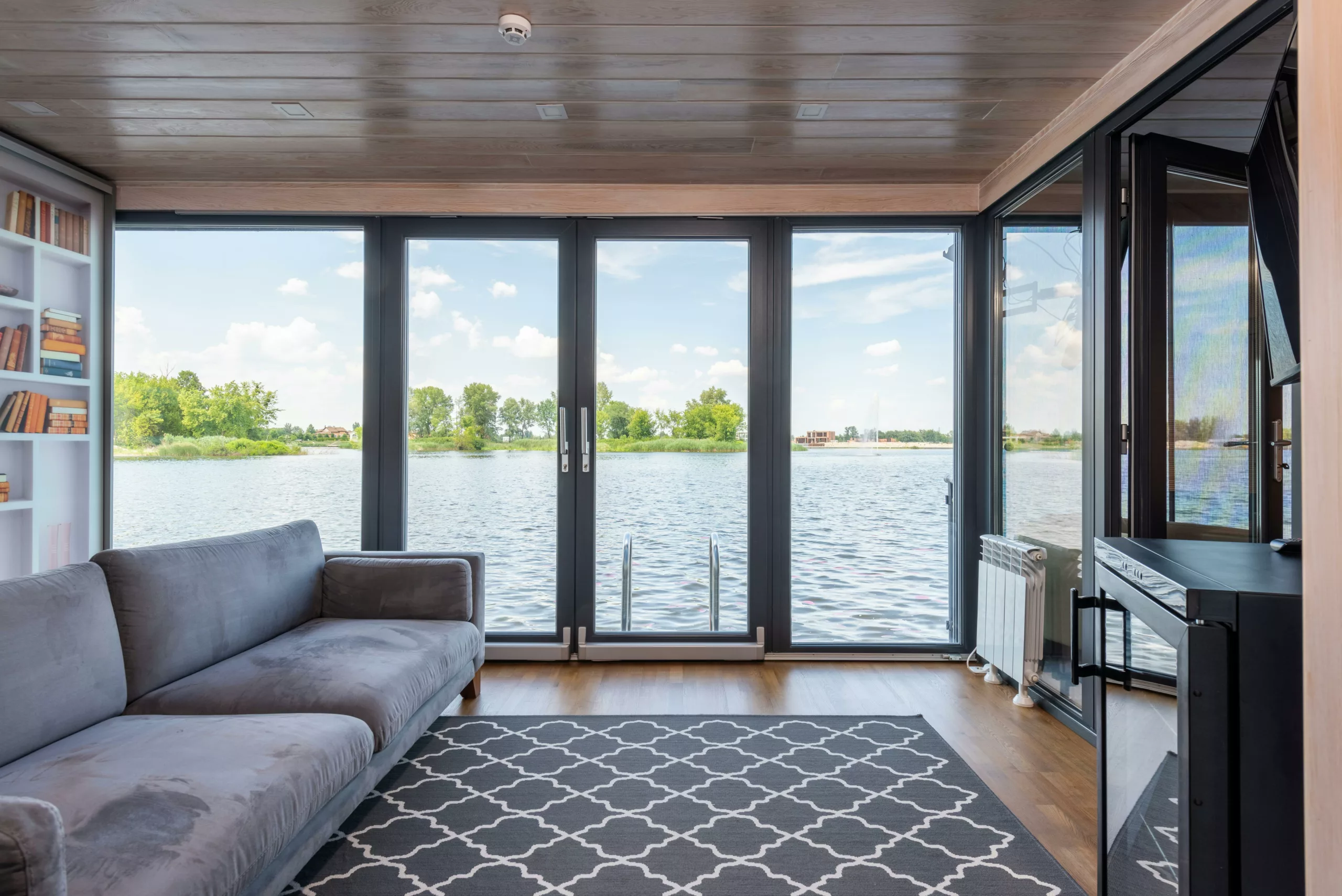
The PSK system (from the German Parallel-Schiebe-Kipp) is one of the earliest and still widely used industry solutions for space-efficient terrace access. The construction is based on standard multi-chamber window profiles with an integrated running gear.
How Does the PSK Mechanism Work?
Understanding this system comes down to its dual-action mechanics. In the closed position, the sash sits flush against the frame, pressing the seals all the way around – exactly like a conventional window, delivering exceptional weathertightness.
Turning the handle to the first position tilts the top edge of the sash, allowing trickle ventilation without unlocking the full panel. Further rotation and pulling the handle towards you slides the entire sash a few centimetres into the room. It then rolls along the bottom track on the threshold, sliding across the fixed part of the frame.
Unlike advanced lift-and-slide systems, the PSK mechanism operates without lifting the sash vertically – the weight rests on the running carriages throughout the entire movement.
Who Is PSK For – Ideal Applications
This system performs best under clearly defined conditions. PSK sliding doors are the optimal choice for apartment buildings, standard-sized balconies, and retrofitting older properties. The built-in tilt function makes them ideal wherever regular ventilation without opening the full panel is a key requirement.
They are the first-choice solution for buyers with a firmly fixed, modest budget, where thermal performance in a standard opening size is the primary concern. Choosing this system assumes that a higher threshold sill won’t affect the mobility of the occupants.
Advantages of PSK Tilt-and-Slide Doors
- Lowest entry price among all sliding door systems – maximum cost efficiency
- Outstanding weathertightness – the mechanism presses the sash against the frame all the way around, creating a hermetic seal against wind and driving rain
- Tilt function for trickle ventilation without opening the full panel – unique at this price point
- Technological commonality with standard window construction – straightforward installation, easy adjustment, and affordable after-warranty servicing
Disadvantages and Limitations of PSK Doors
- High threshold sill prevents a level, step-free transition between the living room and terrace
- Sliding the heavy sash out of the frame requires noticeably more force than lift-based systems
- Susceptibility to mechanism misalignment if operated incorrectly
- Maximum width of approx. 3.3 m rules out the system for panoramic projects
Learn more about our PSK-doors: PSK Sliding Patio Doors
Slide Doors – A Modern Aluminium Alternative Between PSK and HST
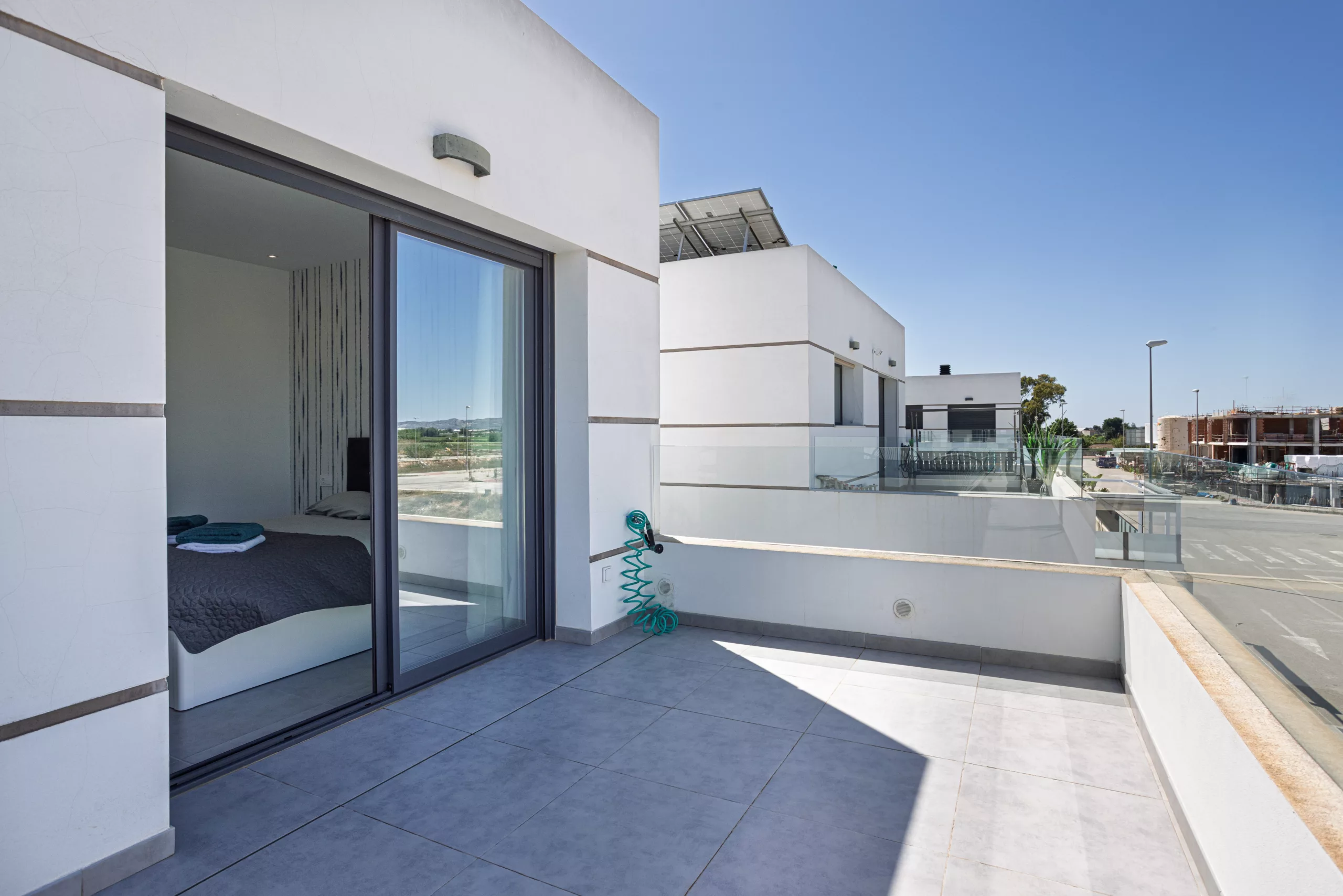
What’s the difference between Slide, HST, and PSK sliding doors? – this is one of the most frequently asked questions at the design stage. The Slide system bridges the technological gap between the budget-friendly PSK and the flagship HST.
What Makes the Slide System Stand Out?
The operating principle relies on innovative concealed running carriages, delivering incomparably quieter and smoother operation than tilt-and-slide systems. Unlike HST, the Slide mechanism does not lift the sash vertically; unlike PSK, it doesn’t require the sash to be pushed inward. Turning the handle releases the locking and reduces pressure on the precisely engineered perimeter seals, allowing the sash to roll along the track with minimal friction.
A defining characteristic of this system family is the dramatically reduced visibility of the load-bearing profiles. Slim aluminium profiles deliver up to 30% more glazed area than standard systems in the same opening – significantly increasing natural light within the interior.
Who Is the Slide System For?
Slide doors are the precise answer for lovers of modern, purist architecture. They work exceptionally well in spacious apartments and houses where slim profiles are an absolute design priority. Variants without intensive thermal insulation – such as the frameless Aliplast Slide Glass – are an outstanding solution for terrace enclosures, bioclimatic pergolas, unheated verandas, and internal partition walls in loft conversions.
The system is aimed at buyers whose budget exceeds that of a standard PVC door, but where the nature of the project doesn’t demand a full-specification, top-of-the-range HST system.
Advantages of the Slide System
- Radically slim aluminium profiles – up to several tens of percent more glazed area within the same opening
- High operating quality – quiet, effortless use without heavy mechanical sliding rails
- Optimal price positioning – a sensible middle ground between budget PSK and premium HST
- Innovative multi-track configurations (3, 4, or even 5 independent tracks) allowing all panels to stack on one side and open up a wide clear passage
- Broad product portfolio – from thermally broken (Slide Plus) to uninsulated “cold” variants (Slide Glass, Ecoslide) for pergolas and verandas
Disadvantages and Limitations of the Slide System
- Exclusive use of aluminium positions the system above comparable PVC constructions in terms of price
- No tilt function – ventilation only via gap opening or fully sliding the panel
- Carriage load limit of approx. 120 kg prevents installation of the heaviest, acoustically rated glazing units that HST mechanisms handle without difficulty
Learn more about our Sliding-doors: Slide Sliding Doors
HST Lift-and-Slide Doors – The Premium Standard
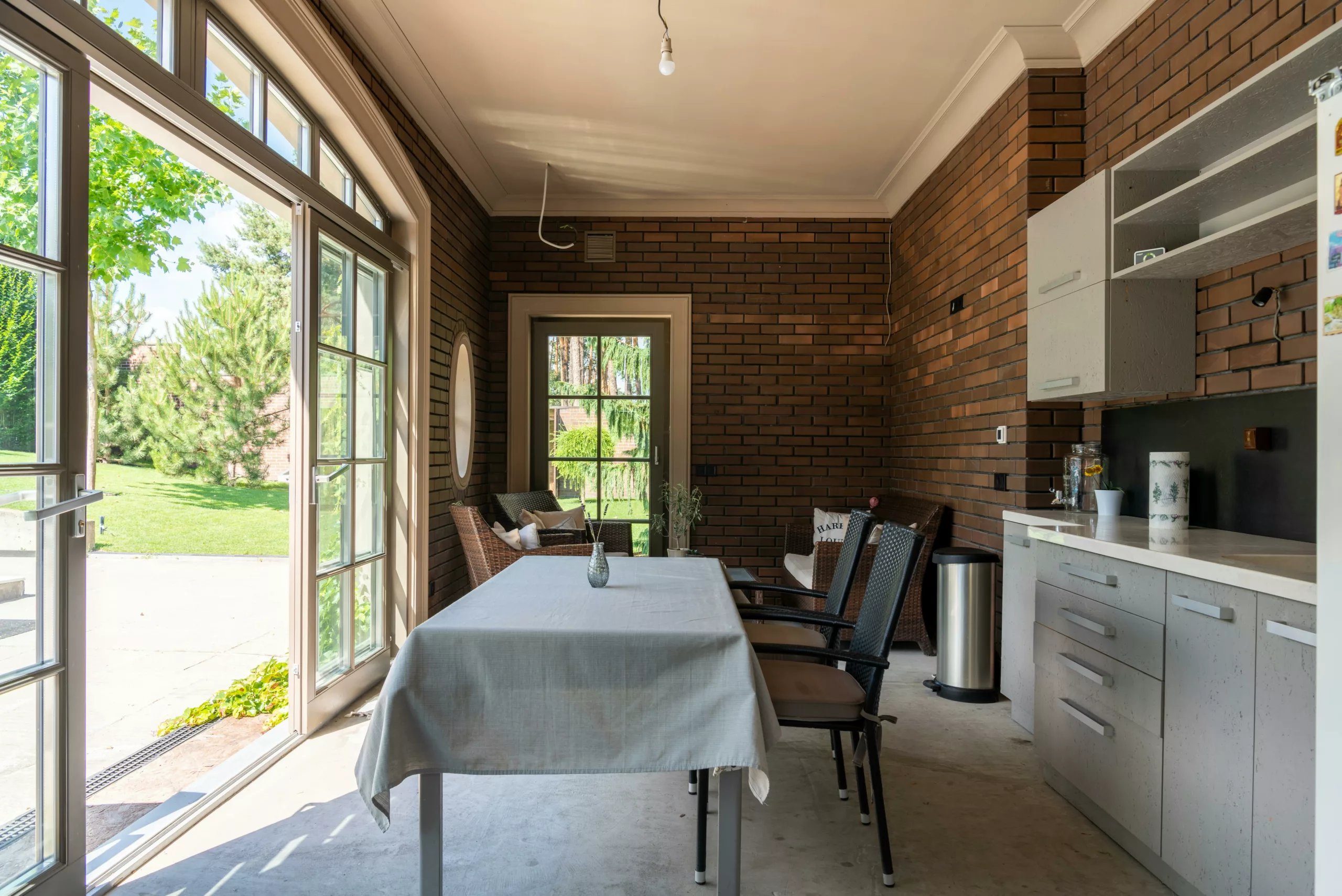
The HST system (Hebe-Schiebe-Tür) is the flagship technology – designed for the most demanding projects where extreme glazing dimensions, outstanding thermal performance, and the highest level of operating comfort are non-negotiable.
How Does the HST Mechanism Work – Why Can “Even a Child Open It”?
Understanding what lift-and-slide doors are and how they work requires a look at the sophisticated mechanics of the concealed hardware. In the resting position, the enormous sash rests directly on the bottom threshold and the perimeter seal system. This static contact pressure, amplified by the weight of the glazing unit, guarantees absolute weathertightness against wind and rain.
Turning the handle activates a complex lever mechanism concealed within the sash frame. Integrated load-bearing carriages extend, physically lifting the entire sash by 5–8 mm. This lift instantly releases the pressure on the bottom and top seals – the sash rests solely on ball-bearing rollers and glides along the track with minimal resistance.
Top-specification hardware – such as Hautau ATRIUM HS – carries a standard load rating of 330 kg, with special variants reaching up to 440 kg. A typical sash weighing 200–250 kg loads the mechanism at only half its rated capacity – hence the effortless operation and many years of trouble-free performance. The system integrates with electromechanical drives, connecting the façade to a full smart home ecosystem.
Who Is HST For?
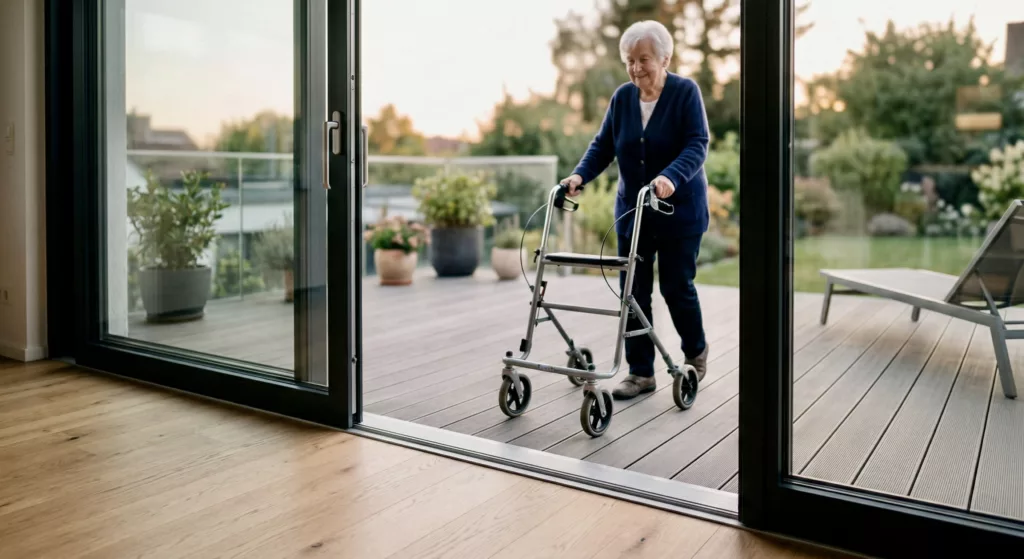
Lift-and-slide doors are an engineering necessity for projects with glazed areas exceeding 10 m². Terrace doors for passive houses and energy-efficient buildings use HST for its exceptional thermal balance (Uw ≤ 0.71 W/(m²K)). The step-free threshold makes it the only correct choice for barrier-free architecture – guaranteeing full accessibility and safety for young children, elderly users, and wheelchair users. It is the ultimate choice for architects designing spacious residences and minimalist villas that dissolve the boundary between interior and garden.
Advantages of HST Lift-and-Slide Doors
- Perfectly level, step-free transition between living room and terrace – the only system guaranteeing full accessibility
- Operating panels weighing hundreds of kilograms with one hand – a technological achievement that far surpasses the PSK experience
- Maximum natural light – the largest possible glazing panels in the building envelope
- Precise locking of the sash at any point along the track
- Concealed hardware and full automation potential with smart home integration
- Energy grant eligibility – certified Uw values qualify for energy efficiency incentive programmes
Disadvantages and Limitations of HST Doors
- Floor construction and drainage must be precisely prepared before ordering the door
- Price several times higher than a comparable PSK configuration
- No tilt function
- Warm-frame installation requires heavy equipment (glass manipulators, cranes), a high-load-bearing foundation, and planning at the earliest project stage
Learn more about our HST-doors::
Bi-Fold Doors – When Maximum Opening Width Matters
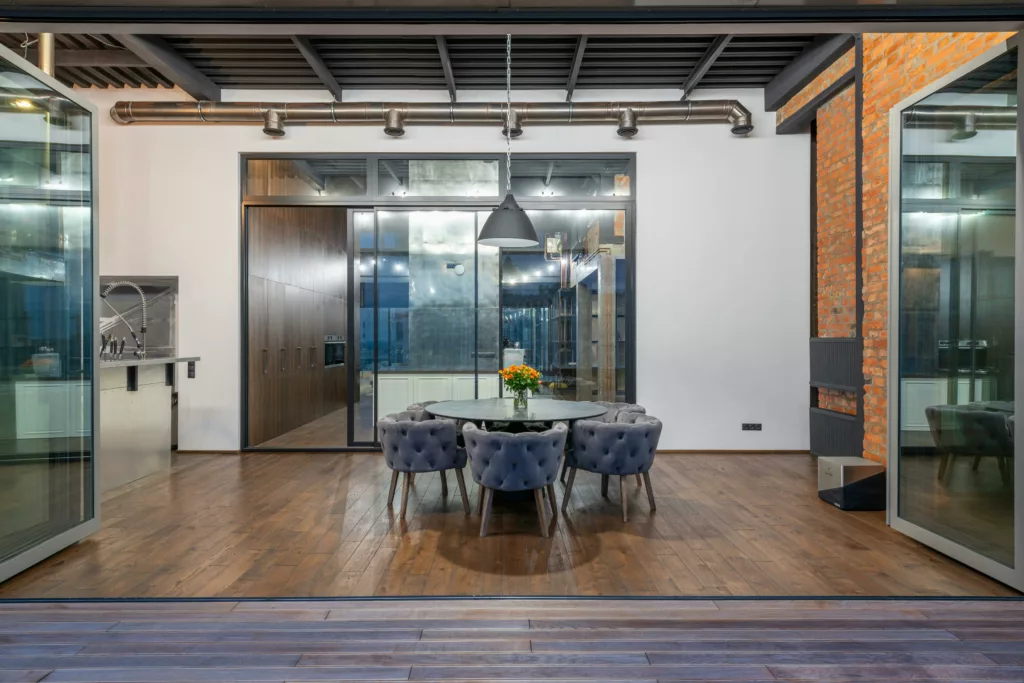
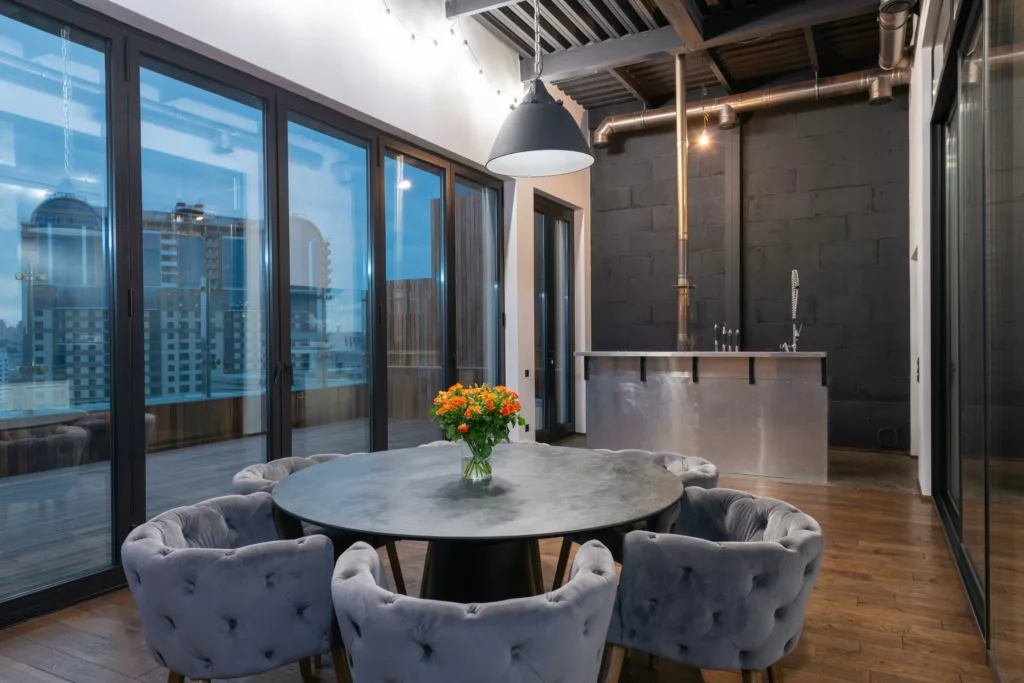
When should you choose aluminium bi-fold doors? When the overriding goal is to completely remove the physical barrier and merge the interior with the surrounding environment.
How Do Bi-Fold (Folding Sliding) Doors Work?
The operating principle resembles a large-format screen. The sash segments are connected vertically by heavy-duty hinges that work in conjunction with precision carriages running in the bottom and top tracks. Unlocking the system releases the locking mechanism, allowing all panels to slide and fold neatly alongside each other.
Unlike HST or PSK – where a significant portion of the glazing must remain within the opening – the “parked” bi-fold stack reveals 90–95% of the original clear opening width.
Who Are Bi-Fold Doors For?
They are essential in the hospitality and food service sector (HoReCa) – restaurants, cafés, and hotels where seamless integration of interior and terrace space is required during the summer season. Picture a lakeside restaurant whose entire front wall folds away, merging the dining room and open air into a single experience. Or a boutique hotel opening its lobby to the garden. These scenarios are technologically beyond any HST system – even the widest HST installations retain fixed glazing elements within the opening.
In the residential sector, bi-fold doors are sometimes the centrepiece of spectacular winter gardens or show-stopping residences seeking the ultimate “wow factor” – where static HST panels simply can’t deliver the desired sense of openness.
Advantages of Bi-Fold Doors
- 90–95% of the clear opening revealed – unachievable with any other system
- Versatile configurations: two to multiple panels, folding inward or outward
- Wide range of finishes: RAL powder coating, wood-effect finishes, anodised surfaces
- Spectacular visual impact – complete opening of the interior to the surrounding environment
Disadvantages and Limitations of Bi-Fold Doors
- Multiple vertical profiles and joint seals mean an accumulation of potential thermal bridges – Uw from approx. 0.9 W/(m²K)
- Regular, thorough maintenance of numerous hinges and tracks is essential
- Highest cost per square metre of opening of all systems – a result of the large number of precision fittings and high-grade aluminium profiles
- Sufficient wall space must be reserved to “park” the folded, bulky panel stack
Learn more about our Bi-Fold doors: Aluminium Folding Doors
HST, PSK, Slide, or Bi-Fold – Which Should You Choose?
The HST vs PSK decision requires a logical mapping of project requirements and budget constraints against the technical characteristics of each mechanism.
Small standard opening (e.g. 2.5 × 2.1 m), tight budget → PSK in PVC. Uncompromising thermal performance at the lowest price. If the specification calls for slightly larger glazing with a tilt function and the budget is more flexible, PSK in aluminium delivers greater frame rigidity and extended carriage life.
Clean, modern aesthetic with the slimmest profiles, no tilt function required → Slide doors. Optimal price positioning combines the visual luxury of large-format glazing with a moderate investment in the sliding system.
Uncompromising luxury, passive house standard, glazing over 10 m² → HST. In the cost-effective PVC variant (Uw ≤ 0.71 W/(m²K)) for a solid family home. In the large-format aluminium variant – for moving façades and designer projects.
Luxury hospitality, hotel sector, maximum 95% clear opening → Aluminium bi-fold. The only system that enables the complete removal of the physical barrier.
Material – PVC or Aluminium?
Selecting the right profile material determines how the entire door assembly behaves under varying thermal stress conditions.
PSK works well in both materials – multi-chamber PVC as an outstanding thermal insulator provides the most cost-effective, energy-saving option. Aluminium delivers greater rigidity and allows for an optically slimmer frame.
HST in PVC is the price-optimised solution for an energy-efficient family home. HST in aluminium takes over when expectations exceed standard size grids – the excellent modulus of elasticity of aluminium alloys protects sashes against deflection and enables radically slim profiles (e.g. 27 mm with Yawal Moreview), with the remaining structure hidden behind façade edges.
Slide and bi-fold doors are firmly in aluminium territory. Multi-track Slide guides require perfect load-bearing stability down to fractions of a millimetre. Folding sashes in bi-fold systems, subjected to tensile forces from multiple hinges, can only operate safely and durably on reinforced aluminium.
The rule of thumb: the larger the opening and the more ambitious the architecture, the more likely the choice falls on aluminium.
Guide Prices for Sliding Terrace Doors
Price positioning reflects technological complexity and structural capability. PSK in PVC is the most budget-friendly option – an attractive entry point for buyers looking for a proven sliding door system at a reasonable price.
Moving to HST in PVC quickly tests budget flexibility – the cost of a lift-and-slide construction is several times higher than a comparable PSK configuration. The market middle ground, bridging the price gap between tilt-and-slide and lift systems, is occupied by Slide systems.
Bi-fold doors carry the highest cost per square metre of opening of all systems – owing to the sheer number of hinge-and-locking mechanisms and the accumulation of costly aluminium profiles. Pricing is calculated individually for each panel configuration.
A key cost component is the warm-frame installation – deploying glass manipulators, cranes, and suction-cup lifters adds a further 15–25% to the frame value. Individual upgrades (P4A anti-burglar glazing, electromechanical drives, wood-effect finishes) define the upper cost ceiling.
Frequently Asked Questions About Terrace Sliding Doors
Are terrace sliding doors secure against break-ins?
HST and PSK systems can meet burglar resistance standards up to RC 3 (in accordance with EN 1627), meaning confirmed resistance to forced entry for a minimum of 5 minutes using tools such as a crowbar or screwdriver. The key is using the appropriate glazing unit (e.g. laminated safety glass class P4A) in combination with multi-point locking hardware. It’s important to note that the RC classification applies to the entire assembly – not just the glass or the profile alone – so the burglar resistance specification must be agreed at the point of ordering.
How long do terrace sliding doors last, and what wears out first?
With correct installation and regular maintenance, PVC and aluminium profiles retain their properties for 30–40 years. The wearing components that require attention are the running carriages and seals – their lifespan depends on frequency of use and hardware quality. With HST systems using Hautau ATRIUM HS hardware (load rating 330–440 kg), the mechanism operates well within its rated limits, translating into many years of trouble-free performance. With PSK systems, the most common issue is misalignment of the sliding mechanism – this requires periodic adjustment by a qualified service engineer.
At what stage of construction must sliding doors be planned?
This is one of the most important questions – and one that is often asked too late. HST doors must be accounted for in the design before the floor screed is poured. This involves preparing a foundation with adequate load-bearing capacity, planning the finished floor depth to align with a flush threshold, and routing linear drainage. Overlooking these elements at the shell stage makes a step-free transition impossible to achieve retrospectively. PSK and Slide systems are less demanding, but even here it’s advisable to confirm the exact opening dimensions with the manufacturer before ordering the lintel.
How are sliding doors maintained – what can you do yourself, and what should be left to a professional?
DIY maintenance: clean the running tracks of sand and debris (quarterly), treat seals with a silicone-based product before winter, and wash profiles with pH-neutral cleaning agents. Leave to a qualified installer: adjustment of seal contact pressure and sash plumb (every 1–2 years), inspection of running carriage condition, and replacement of wearing components as required. For bi-fold doors, maintenance is more involved – numerous hinges and tracks require systematic lubrication and play inspection.
Can external blinds or shutters be fitted to terrace sliding doors?
Yes, but this must be planned at the design stage. For wide HST and Slide glazing, the most commonly used solutions are zip screen blinds or external venetian blinds. Zip screens have a clear advantage at very large formats – the fabric, guided in sealed side channels, withstands wind gusts of up to 120 km/h. The critical requirement is to provide roller blind boxes of adequate depth within the lintel – retrofitting them after door installation is costly and often a visual compromise.
What is the minimum and maximum opening width for sliding doors?
The practical minimum width is approx. 1.5 m for PSK – below this, a sliding door loses its functional rationale. Maximum width depends on the system:
- PSK: up to approx. 3.3 m
- Slide: up to approx. 6.5 m
- HST PVC: up to approx. 6.5 m
- HST aluminium (e.g. Yawal Moreview): spectacular multi-track constructions reaching up to 18 m
Bi-fold doors have no fixed maximum width – each additional panel widens the opening, but also increases cost and maintenance complexity.