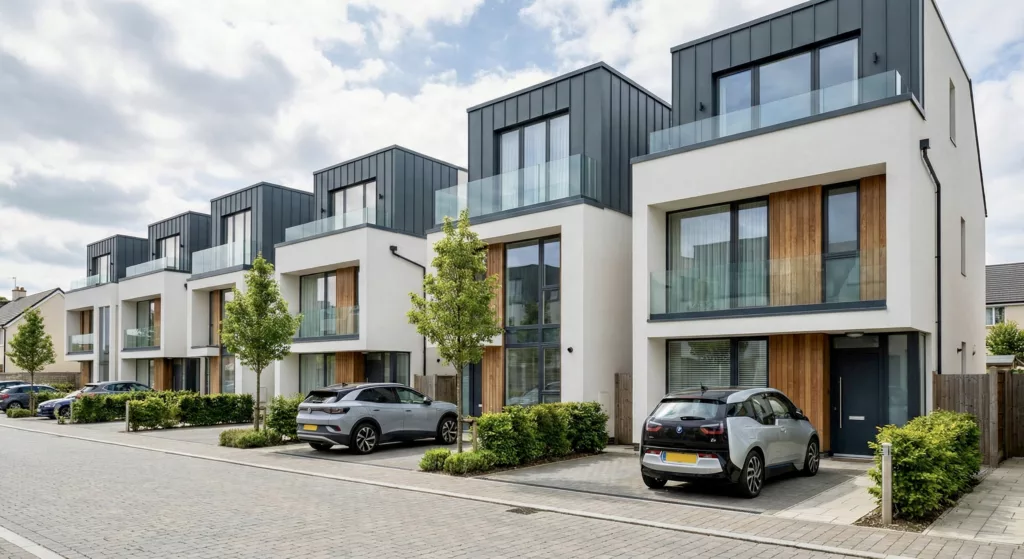


When to Order Windows, Doors, Facades and Conservatories: The Complete Construction Timeline
Fenestration products are among the most frequently underestimated elements in any construction schedule. The scenario is a familiar one — the building is approaching the weather-tight stage, the plastering crew is standing by, and the windows still haven't arrived. Because the order went in too late. Because no one warned the client that lead times can double during peak season. Whether you're replacing windows in an existing home, building from the ground up, adding a conservatory, or specifying an aluminium curtain wall facade — you need to know exactly when to place your order to avoid bringing the entire project to a standstill. Each product category comes with its own lead times and technical requirements.

Lead Times at a Glance
The differences in lead times come down to technological complexity. A standard PVC window leaves the production line within days. An aluminium curtain wall facade requires a bespoke technical design with structural calculations before manufacturing can even begin. A conservatory adds regulatory procedures on top of that.
Typical lead times from order to installation:
- PVC windows (GEALAN S8000/S9000) — approximately 4 weeks. Non-standard foil finishes, arched or trapezoidal shapes may add several days.
- PVC/aluminium entrance doors — approximately 4 weeks. Longer when bespoke decorative panels or electronic access systems (biometric locks, fingerprint readers) are involved.
- HST lift-and-slide doors — 4 to 6 weeks. Heavy laminated safety glass and specialist lifting hardware have their own supply chains that set the pace.
- Aluminium curtain wall facades — 6 to 12 weeks. The technical design alone can take several weeks before profile manufacturing begins.
- Aluminium conservatories — 6 to 12 weeks for production alone, plus time for planning permission or building notification procedures.
- External roller shutters — 2–3 weeks. Best ordered alongside windows so installation can be completed in a single visit.
These timescales apply outside the peak construction season. From March through July, when production capacity is at its highest demand, waiting times for all of these products can stretch significantly — in extreme cases, they may double.
PVC Windows and Doors — A Step-by-Step Ordering Guide
This section covers standard fenestration: PVC windows, entrance doors and PSK tilt-and-slide patio doors. If you’re building a new home, the steps below slot directly into your construction programme. If you’re replacing windows in an existing building, skip ahead to the survey section — that’s the step that triggers production.
New build: consultation at design stage (12–18 months before moving in)
Key decisions affecting the technical feasibility of your glazing are made at the architectural design stage. Architects draw openings based on the look of the elevation — but they don’t always know the structural limitations of specific profile systems.
This is why an early consultation with the manufacturer pays dividends. It’s not uncommon to find that a desirable panoramic window configuration requires an additional structural mullion, or that a planned opening is simply too wide for the chosen system.
It’s also worth verifying local planning regulations regarding building setbacks and boundary distances at this stage. Requirements vary by country and municipality, but typically a wall containing windows or doors must maintain a minimum setback from the property boundary — often 3 to 4 metres depending on jurisdiction. These rules can directly influence where large glazed openings and sliding doors are actually possible, which in turn determines what you order and when.
An early budget estimate lets you plan finances realistically before any groundworks begin.
Survey — the step that triggers production
For new builds, the ideal moment to place a firm order is when the building reaches the open shell stage — walls up, floors poured, roof on. Only then do the openings have their final, as-built dimensions. Ordering earlier, from architectural drawings alone, carries real risk — dimensional discrepancies of 20–50 mm between drawings and the finished structure are commonplace on construction sites.
When replacing windows in an existing building, a survey can be commissioned at any time. From survey to installation typically takes 4–5 weeks.
A note for those planning window replacement as part of an energy efficiency retrofit: make sure the specified products meet the requirements of any grant or incentive programme you’re applying for. For example, under international energy efficiency frameworks and schemes such as those administered through national energy agencies, thermal transmittance thresholds typically range from Uw ≤ 0.95 to 1.3 W/(m²K) depending on the programme. The GEALAN S8000 and S9000 systems in the BWS range comfortably exceed the most demanding of these thresholds.
Warm-edge installation: three-layer thermal protection and its impact on the schedule
The warm-edge installation method seals the joint between the frame and the surrounding masonry in three distinct layers. On the interior face — a vapour-tight tape (butyl or film-based) that prevents moisture from heated rooms migrating into the installation zone. In the middle — low-expansion polyurethane foam that eliminates thermal bridges. On the exterior face — a vapour-permeable or expanding EPDM tape that shields the foam from UV degradation and rain while allowing water vapour to diffuse outward.
The traditional approach of sealing with foam alone — without tapes — creates a thermal bridge that over time leads to condensation, mould growth and plaster deterioration around the frame. Heat losses through a poorly installed window can be 8–12% higher than with correct three-layer installation.
Why does this matter for the schedule? Warm-edge installation requires properly prepared reveals — the masonry around the opening must be smooth, level and free of voids. In new construction this is standard practice. When replacing windows in an older building, reveals often need to be made good with mortar beforehand — something that needs to be factored into the programme.
Closing the building envelope and wet trades
Once windows and doors are installed, the building moves to the closed shell stage. This is the milestone every subsequent trade is waiting for — plasterers, services engineers, floor layers. The fundamental rule: fenestration must be in place before wet trades begin. Plastering and screeding introduce enormous quantities of construction moisture into the building, and for that moisture to evaporate in a controlled manner, the envelope must be closed.
In practice the picture is slightly more nuanced than the simple rule of ‘windows first, plastering after’ suggests. Wet trades generate extreme internal humidity — sometimes above 90%. Once windows are installed, intensive ventilation or mechanical drying becomes essential. Without it, water vapour condenses on glazing and in severe cases can lead to mould developing on fresh reveals.
Two non-negotiable rules apply once fenestration is installed and plastering begins: protective films on profiles and glass must stay on until all wet trades are complete, and the building must be actively ventilated — ideally mechanically. Removing those films before plastering and screeding is finished is one of the most common mistakes made by finishing crews, because plaster mortar embeds itself into unprotected profiles and is extremely difficult to remove cleanly.
When replacing windows in an occupied home the sequence is different. Here the priority is speed of installation (a single window swap typically takes a few hours) and adequate protection of the interior against dust and draughts.
HST Lift-and-Slide Doors — Why They Demand Early Planning
HST lift-and-slide doors are an entirely different category from standard windows or conventional patio doors. The Yawal DP180 Primeview system achieves a Uw value from 0.70 W/(m²K) with acoustic performance of Rw = 47 dB, while the Yawal Moreview allows moving glass walls up to 18 metres wide. At these dimensions, simply ‘ordering a door’ is not enough.
What the structural design must include
If you’re building a new home and planning HST doors, several items must appear in the structural drawings well before any order is placed:
- Reinforced lintels. A single HST panel can weigh 400 kg or more. A standard lintel designed for a regular window simply won’t cope — the structural engineer must specify appropriate reinforcement from the outset.
- Sub-sill foundation. Low-threshold HST doors require a rigid, thermally broken sub-sill substrate (Purenit, XPS or steel supports). Without this, the lifting mechanism will begin to jam within a few years.
- Precise opening alignment. There is no tolerance for adjustment here as there is with standard windows. Installation must be exact from the very first millimetre.
- Boundary setback compliance. HST openings are subject to the same boundary distance rules as any other glazed opening. Verify this at design stage — repositioning an HST opening after walls are built is a scenario best avoided.
Installing HST doors in an existing building
Replacing existing patio doors with HST in a finished home is more complex. The load capacity of the existing lintel must be assessed — and it frequently proves to need reinforcement. These are structural works that must be planned before the door order is placed, as installing HST in an unprepared opening is simply not possible.
HST door lead time: 4–6 weeks as standard, during peak season potentially 8–10 weeks.
Aluminium Curtain Wall Facades — When to Start Planning and Why So Early
An aluminium curtain wall facade cannot be ordered at the last minute. The difference between a standard PVC window and a curtain wall is the same as the difference between an off-the-shelf piece of furniture and a fully bespoke fitted kitchen. The window comes off a production line. The facade is engineered from scratch for a specific building — whether that’s a private house with a dramatic glazed elevation or a commercial property.
No technical design, no order
Before any contract can be accepted, structural engineers must produce a dedicated design: load calculations (wind and thermal), bracket spacing, aluminium mullion sizing, glass unit specifications and drainage systems.
Producing this documentation alone takes several weeks — and only then does manufacturing begin. Total time from decision to completed facade: a minimum of 2–4 months.
Why the facade must be planned alongside the building structure
Large-format facade glazing is extremely heavy — individual glass units can reach 1,400 kg. The building structure must be engineered to carry this load, which means appropriate reinforcement of floor slab edges and ring beams, specified from the very beginning of the design process.
Attempting to install a curtain wall after the external insulation is complete creates serious complications. The steel support brackets must be anchored directly into the reinforced concrete structure. Once the building is insulated and rendered, the completed facade finish has to be stripped back, slots cut into the concrete, and insulation continuity restored. The cost of this kind of remedial work can run to tens of thousands of dollars.
Three phases of facade installation
Physical installation is tightly synchronised with the construction programme:
- Support brackets and steel substructure — immediately after structural concrete works are complete, while the building is still at open shell stage. This step cannot be done later.
- Aluminium grid (mullions and transoms) — after walls are up but before external insulation and rendering. The fixing anchors are buried within the insulation layer and create no thermal bridges.
- Glazing — during the final fit-out phase. Glass panels weighing several hundred kilograms each require mini-cranes and vacuum handling equipment, so the expensive glazing goes in last, once all other trades have left the site.
Aluminium Conservatories — Ordering Timelines for New Builds and Extensions
A conservatory is simultaneously a glazed building element and a standalone architectural structure. The ordering timeline looks quite different depending on whether the conservatory is being built as part of a new home or added as an extension to an existing property. In practice, the vast majority of conservatories are built as extensions — so we’ll start with that scenario.
Adding a conservatory to an existing home
This is a standalone construction project subject to local planning regulations. The process depends on the size of the structure:
- Smaller structures (thresholds vary by country and local authority — commonly up to 15–30 m² in many jurisdictions) — a building notification or permitted development application may suffice, subject to meeting boundary setback requirements and other local conditions.
- Larger structures — a full planning application with architectural drawings is typically required. Statutory determination periods vary, but allow for 2–3 months in your programme as a minimum; in practice it can take longer.
Tax and incentive note: In many countries, energy efficiency improvements including glazed extensions to residential properties may qualify for tax relief or grant funding. Schemes vary significantly by country — consult your local energy agency or tax authority for current provisions.
From the decision to a finished conservatory typically takes 3 to 6 months. The physical installation of the aluminium structure itself takes just 3–5 working days. The rest of the time is consumed by regulatory processes, foundation work and waiting for production.
Planning a conservatory as part of a new build
This is the ideal scenario from a regulatory standpoint. The conservatory forms part of the building application and is covered by the same planning consent — no additional procedures required. Foundations for the conservatory are poured at the same time as the main house foundations, with an XPS styrofoam expansion joint to prevent cracking from differential settlement.
The order for the aluminium structure is placed at the same time as the window order — when the open shell is being closed out. Installation follows in the fit-out phase.
Tax Incentives and Energy Efficiency Grants
This is a topic that directly affects how you structure your order. In many countries, the purchase of fenestration products on its own attracts full standard rate VAT. However, when windows and doors are supplied together with professional installation as part of a residential energy efficiency project, reduced tax rates or direct grants may apply.
Eligibility criteria typically depend on factors such as the building type, its age, the thermal performance of the products being installed, and whether works are carried out by an accredited installer. The products must usually meet minimum Uw thresholds — commonly in the range of Uw ≤ 0.95 to 1.3 W/(m²K) depending on the scheme.
The GEALAN S8000 and S9000 systems from the BWS range substantially exceed even the most demanding energy performance thresholds. When placing an order, it’s worth confirming upfront whether the installation is to be included in the contract — as this can determine eligibility for incentive schemes.
Always check current provisions with your national or regional energy agency, as programmes and thresholds change regularly.
Why Ordering Ahead Pays Off
The fenestration market has a pronounced seasonal pattern. From March through July, production capacity is stretched to its limit — factories run flat out, glass and aluminium profile suppliers carry backlogs, and lead times extend accordingly.
Placing an order outside this period — from November through February — means shorter, more predictable lead times. Production runs at normal capacity without delays caused by overloaded lines. Finished products can be held in the manufacturer’s warehouse until the site is ready for installation.
The proven strategy is this: survey in autumn (for new builds, after the roof is on), sign the contract around the turn of the year, and install in the first weeks of spring. For window replacement in an occupied home the season matters less — but even here an early order avoids weeks of unnecessary waiting.
Practical Construction Timeline for a New Home (18 Months)
The following schedule covers a house built from the ground up. Not every line will apply to your project — select the items relevant to the products you’re ordering.
Months 1–3: Design and planning permission
Early budget estimate for fenestration based on architectural drawings. Verify boundary setback requirements for window and door openings under applicable local planning rules. If HST sliding doors are planned — verify opening structural requirements with the engineer. If a conservatory is included — incorporate it into the planning application. If an aluminium curtain wall facade is planned — begin technical design now, as this is the longest lead-time element in the entire schedule.
Months 4–6: Foundations, walls and floors
Finalise selection of profile systems. For aluminium facades — install steel support brackets into freshly cast structural concrete floor slabs. This step cannot be completed later, and without it the facade cannot be built.
Months 7–9: Open shell stage
Time for a precise as-built survey of reveals and placement of orders for PVC windows, entrance doors, built-in roller shutters and HST sliding doors. For facade projects — order glass units. From survey to installation of standard fenestration: 4–5 weeks.
Month 10: Closing the envelope
Installation of windows and doors using three-layer warm-edge installation (vapour-tight interior tape, low-expansion foam, vapour-permeable exterior tape). For facades — parallel installation of the aluminium grid. The building moves to closed shell stage and internal wet trades begin.
Months 11–12: Plastering, screeding and services
Fenestration protected with factory-fitted films — do not remove until all wet trades are complete. Mechanical drying and intensive ventilation to prevent construction moisture condensing on glazing and causing mould on fresh reveals. If a conservatory extension is planned but wasn’t included in the original build — now is a good time to place the production order and begin the planning process.
Months 13–15: Fit-out and external works
For facades — glazing, i.e. inserting heavy glass panels into the aluminium frames. This happens after external plastering/rendering is complete, so that insulation laps cleanly over the aluminium frame.
Months 16–18: Inspections and handover
Any conservatory installation takes place at this stage (3–5 working days).
Common Ordering Mistakes to Avoid
Windows ordered from drawings without an as-built survey. The most common mistake in new construction. A window manufactured to architectural drawing dimensions almost never fits the finished opening precisely. Too large — the structural opening has to be mechanically enlarged. Too small — a new order and weeks of delay.
Order placed too late in the construction season. The knock-on effect: a few weeks’ delay on window installation blocks the plasterers, services engineers and floor layers from starting. Every week of standstill means real costs — scaffolding hire, contractual penalties from finishing trades, mounting loan repayments.
Roller shutters omitted from the window order. A separate installation at a later stage means disturbing the finished insulation above the lintel, creating a thermal bridge and requiring a second site visit from the installation crew. Ordered alongside the windows, they are installed as a single airtight system.
Skipping warm-edge installation. Setting a window using polyurethane foam alone — without vapour-tight and vapour-permeable tapes — creates a thermal bridge around the entire frame. Over time this leads to condensation, mould and heat losses of 8–12%. A window with a Uw value of 0.75 W/(m²K) installed using the traditional method loses a significant proportion of its designed thermal performance.
Facade ordered after external insulation is complete. A mistake that cannot be rectified without major demolition work. Facade support brackets must be anchored into the reinforced concrete core of the building — the completed insulation and render must be removed to achieve this.
Conservatory built without regulatory approval. An unauthorised structure. Retrospective regularisation procedures involve substantial costs, and where boundary setback rules have been breached, a demolition order may follow.
HST doors fitted into an unprepared opening. Installing a door weighing over 400 kg on a standard lintel risks structural deflection. Upgrading a lintel after the fact requires engineering works and costs many times more than designing it correctly from the start.
Protective films removed too early. Films on profiles and glass must remain until all wet trades are complete. Plaster mortar, cement dust and screed slurry embed themselves into unprotected surfaces and are virtually impossible to remove without damaging the profile finish.
FAQ — Frequently Asked Questions
At what construction stage should I order windows? Once the open shell stage is reached — walls up and roof on. Only then do the openings have their final dimensions, making an accurate survey possible.
How long does it take from order to delivery? From survey to installation typically 4–5 weeks. During the peak construction season (March–July) lead times may be longer.
Is it worth ordering outside the season? Yes — an order placed between November and February means shorter lead times and a more predictable schedule. Finished products can be held at the manufacturer’s warehouse until spring installation.
When should entrance doors be installed? Together with the windows — ideally in a single visit, so the building envelope is closed in one go.
How long does HST door production take? 4 to 6 weeks as standard, longer during peak season. Heavy laminated safety glass and specialist lifting hardware extend the overall process compared to standard windows.
When should planning for an aluminium facade begin? At architectural design stage — 12–18 months before occupation. Support brackets must be cast into the reinforced concrete structure of the building.
Does a conservatory require planning permission? Requirements vary significantly by country and local authority. Smaller structures often qualify under simplified notification procedures; larger ones typically require a full planning application. Always check with your local planning authority before proceeding.
What is warm-edge installation and why does it matter? Warm-edge installation is a three-layer seal of the joint between the window frame and the surrounding masonry: a vapour-tight tape on the interior, low-expansion foam in the middle, and a vapour-permeable tape on the exterior. It eliminates thermal bridges and ensures the window actually performs to its rated Uw value in service.
How do I protect windows during construction? Factory protective films stay on profiles until all wet trades are complete. Frame reveals should be additionally masked with painter’s tape and covered with boards leaving a ventilation gap. Don’t remove glazing films prematurely — plaster mortar is very difficult to clean off. During plastering and screeding the building must be actively ventilated.
Can I order windows based on drawings? A preliminary budget estimate — yes, and the earlier the better. A binding production order — only after an as-built survey. Ordering from drawings alone is the most common mistake made by self-builders and developers.
When is the best time to install roller shutters? Alongside the windows. Only then is thermal insulation continuity guaranteed and costly remedial work avoided.
Can I order a conservatory independently, without other products? Yes. A conservatory is a self-contained structure that can be added to an existing home at any time. All that’s required is the appropriate regulatory approval and foundation preparation.
Can an aluminium curtain wall facade be installed on an existing building? Technically yes, but it requires a detailed structural assessment. The key question: do the floor slabs and ring beams have sufficient load capacity to accept the facade support brackets? A structural engineer will determine this from the building’s documentation.
Five Golden Rules for Ordering Windows and Doors
- Commission surveys on the finished structure — never from drawings alone. A discrepancy of a few centimetres can mean a complete reorder.
- Plan aluminium facades in parallel with the building structure. Support brackets must be cast into the concrete months before installation — once that stage has passed, it’s too late.
- Always order roller shutters alongside windows. A separate installation at a later stage means disturbing finished insulation and paying for an extra site visit.
- Order ahead — ideally outside peak season. Shorter lead times and a more predictable schedule are concrete, measurable benefits, whether you’re ordering windows, doors, a facade or a conservatory.
- Windows must go in before wet trades begin — and active ventilation must follow. A closed envelope without ventilation is a direct route to condensation and moisture damage.