

Windows for Terraced and Semi-Detached Houses – What to Consider When Choosing
So you've bought a unit in a terraced development or you're planning to build a semi-detached home? Congratulations – the dream of owning a house with a garden is coming true. But before you start picking wall colours for the living room, there's a decision ahead of you that will shape your comfort for the next twenty to thirty years. We're talking about windows. And here's the problem: most online guides treat terraced houses the same as detached properties – but they're a completely different challenge. Different acoustics, different façade layouts, different spatial constraints. A neighbour through the wall, a narrow plot, a garden the size of a pocket park. All of this demands windows that are carefully chosen for your specific situation – not just "any triple-glazed unit off the shelf".
Terraced vs. Semi-Detached – Why It Matters for Your Window Choice
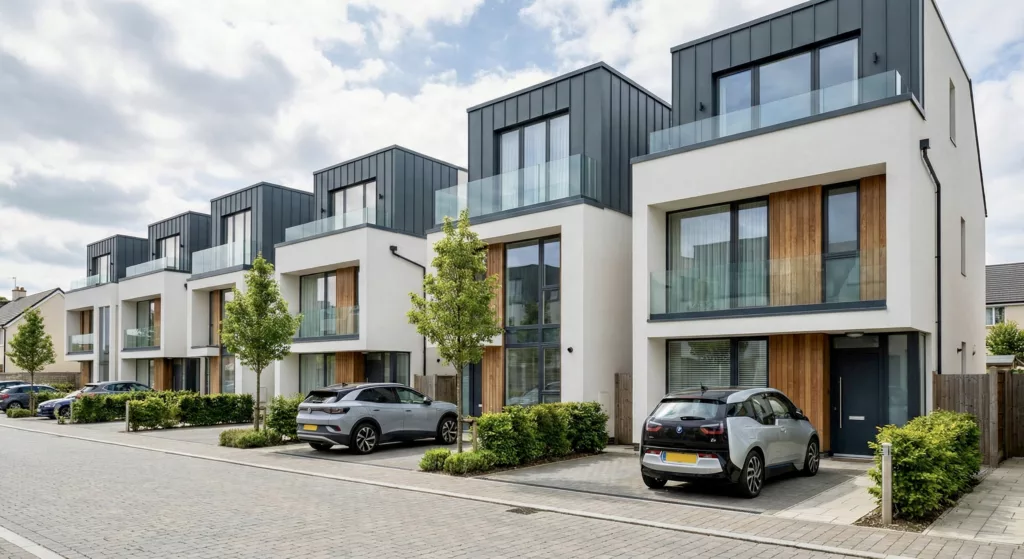
Before we get into specifications, it’s worth understanding a fundamental difference that most window manufacturers overlook. Terraced houses and semi-detached homes present two distinct architectural challenges – even if they look similar from the outside.
The Mid-Terrace Unit – A Light Trap with Two Outer Walls
A mid-terrace unit has windows on only two sides: the front and the rear. The side walls are shared party walls with neighbours, with no window openings at all. This means the entire central section of the house – the hallway, staircase, and often the bathroom – receives no natural daylight. The only way to bring light into the depth of such a building is through large glazed openings at the rear, which effectively become the primary daylight source for the entire ground floor.
This two-sided exposure also changes the energy balance. A detached house gains solar energy from four sides – a mid-terrace unit operates purely on a front-to-back axis. If the front faces north and the garden faces south (or vice versa), you need to specify different glass packages for each façade independently.
The Semi-Detached Home – Three Façades, More Possibilities
A semi-detached home shares only one wall with its neighbour. The remaining three façades are independent, giving you significantly more design flexibility. You can add side windows in the bathroom, bring natural light into the stairwell, or even plan corner glazing. This façade asymmetry is an advantage worth exploiting when selecting your joinery.
The difference also has an acoustic dimension. In a terraced house, noise can arrive from two neighbours simultaneously; in a semi-detached, only from one. This directly affects how seriously you need to approach the acoustic performance of your windows.
Acoustic Insulation – the Specification That Determines Your Peace and Quiet
In a detached house on a generous plot, noise is mainly a street problem. In terraced and semi-detached developments, there’s an additional – often more irritating – issue: close-proximity living. Conversations on a patio three metres away, a lawnmower running behind the fence, children playing in a neighbouring garden – this is an entirely different character of noise from the steady hum of a road.
Two Noise Sources, Two Different Approaches
Traffic noise from the front consists mainly of low frequencies – the rumble of vehicles, vibrations from lorries. This is reduced primarily through thicker glass packages and increased glass mass. Neighbourhood noise – conversations, music, barking dogs – occupies the mid and high frequency range and requires a different approach. Here, asymmetric glazing units play a key role: packages made up of panes of different thicknesses, such as 6 mm on the outer pane and 4 mm on the inner, break up resonant frequencies and suppress everyday noise far more effectively than a symmetrically matched unit of the same mass.
Which Rw Rating Should You Choose?
The Rw value defines a window’s acoustic insulation performance in decibels. A difference of three decibels corresponds in practice to halving the perceived noise level – the relationship is logarithmic, not linear.
For a quiet suburban estate with minimal traffic, windows rated at Rw 32–35 dB are sufficient. In a typical terraced development, however – where neighbours live literally over the fence and an estate road runs along the front – a minimum of 40–42 dB is required. If the house sits on a busy road or the immediate neighbourhood is particularly noisy, targeting values above 45 dB is well worth it.
The GEALAN S8000 system offered by BWS Technika Budowlana achieves acoustic insulation of up to Rw 47 dB, while the premium GEALAN S9000 reaches up to 48 dB in PSK sliding door configuration and up to 50 dB in the window version with an appropriately specified glass package. These are ratings that effectively block typical estate noise and guarantee acoustic comfort even when neighbouring gardens are in full use.
External roller shutters provide an additional acoustic layer – when closed, they reduce noise by around 10 dB, which makes a significant practical difference in the evenings and at weekends.
Energy Efficiency – International Standards and Real-World Savings
What Does Uw ≤ 0.9 W/(m²K) Mean in Practice?
Modern building regulations impose a clear requirement: the thermal transmittance of windows must not exceed 0.9 W/(m²K). Every window installed in a new building or replaced as part of a thermal renovation must meet this threshold.
But meeting the minimum standard is only the starting point. In a terraced house, where windows are the only glazed elements on two façades (the side walls are solid shared party walls), their thermal performance has a proportionally greater impact on the building’s overall energy balance than in a detached home with windows on all four sides.
Matching the Glass Package to Façade Orientation
A north-facing front façade loses heat without gaining solar energy – here, the priority is the lowest possible Uw value. The GEALAN S9000 system with triple glazing and a centre-pane U-value (Ug) of ≤ 0.5 W/(m²K) achieves whole-window Uw values from 0.71 W/(m²K), far exceeding regulatory requirements and translating into real heating cost savings of 25–30% compared with older windows rated above 2.0 W/(m²K).
The garden-facing façade – particularly when it faces south or west – additionally requires consideration of the total solar energy transmittance (g-value) and light transmittance (LT). Modern low-e coatings allow generous daylight to enter while blocking excessive solar heat gain: critical in a terraced house where the large rear glazing is the only light source for the depth of the ground floor, but which in summer can turn a living room into a greenhouse.
GEALAN S8000 or S9000 – Which System for a Terraced House?
Both systems in the BWS Technika Budowlana range comfortably meet current building regulations and qualify for energy efficiency grant programmes. They differ, however, in their intended applications.
The GEALAN S8000 is a six-chamber PVC profile with a 74 mm frame depth, accepting glass packages up to 48 mm thick. It achieves Uw values down to 0.78 W/(m²K) and acoustic insulation of up to Rw 47 dB. This is the proven, practical choice for a typical window replacement in an existing terraced house – outstanding value for money and an excellent fit within standard reveals in older buildings.
The GEALAN S9000 is the premium solution: a six-chamber profile with an 82.5 mm frame depth, designed for triple-glazed packages up to 52 mm thick. Uw values from 0.71 W/(m²K), three EPDM seals rather than two, and certification from the Passive House Institute in Darmstadt. This is the system for homeowners building a new semi-detached property or retrofitting an existing house to energy-efficient standards. The STV® static glass bonding technology eliminates the need for heavy steel reinforcement, enabling larger and more structurally stable sliding constructions.
For more on passive house window parameters and why they matter, see our guide to passive house windows.
Garden-Facing Windows and Doors – the Heart of the Terraced Home
If there is one place in a terraced house that truly defines everyday quality of life, it is the transition from the living room to the patio. In a typical terraced property, this is the only substantial ground-floor glazing – it brings daylight into the depth of the home, connects interior and garden, and creates a sense of greater space. A poorly chosen patio door isn’t just wasted money: it’s a daily source of frustration.
Why Conventional Hinged Doors Are a Mistake in a Terraced House
A typical terraced garden is six to eight metres deep and perhaps five to six metres wide. The ground-floor living room is proportionally narrow. A classic swing patio door that opens inward takes over a square metre of valuable floor space when open. In a 25 m² living room, that’s over five percent of the total area – as much as a comfortable armchair occupies.
PSK or HST – Which Sliding Door System to Choose?
The PSK system (tilt-and-slide) is a practical compromise. A single handle action tilts the panel for ventilation, then glides it smoothly along the fixed glazing. It takes up no interior floor space, offers solid weathertightness through its compression mechanism, and is available at a more accessible price point. In the GEALAN S8000 PSK system, patio doors achieve a Uw of 0.77 W/(m²K); in the S9000 PSK, from 0.71 W/(m²K) with acoustic insulation up to 48 dB – values that rival a fixed window panel, not a sliding door.
The HST system (lift-and-slide) is the premium tier. Its mechanism raises the panel by a few millimetres, releasing the seal compression, then allows it to travel on precision running carriages. The result: even four hundred kilograms of glass moves with a fingertip. The key advantage of the HST in a terraced house is the ability to specify a very low or fully flush threshold, which dissolves the boundary between the living room and the patio and makes a compact space feel larger. PVC-framed HST glazing achieves surface areas of up to 14 m² with thermal values of Uw from 0.60 W/(m²K).
For a detailed comparison of both systems – including mechanism analysis and application guidance – see our article: HST vs PSK – how to choose the perfect sliding patio door.
Aesthetics and Colour – Balancing Personal Style with Uniform Street Frontage
The owner of a detached house chooses window colours entirely to taste. In terraced and semi-detached developments, the situation is more constrained – the developer, the residents’ association, or local planning conditions often prescribe a uniform external appearance. Changing the exterior colour without consent can mean being required to restore the original finish at your own expense.
The solution is dual-colour (bicolour) joinery. Both GEALAN systems in the BWS range allow a different colour on the exterior face from the interior. On the street side, the windows maintain the anthracite or charcoal required by the residents’ association; inside, you can choose a warm wood effect from the Realwood® collection or a clean contemporary white.
It’s also worth considering colour durability. In dense residential developments, frames are exposed to mechanical damage – bicycles leaning against walls, garden equipment, children’s footballs. The GEALAN-acrylcolor® technology used in the S9000 system bonds the PVC profile with a 0.5 mm layer of hard acrylic glass (PMMA) that is exceptionally scratch-resistant and retains its deep colour for decades. Tests conducted to international standards show an almost imperceptible colour change (ΔE < 2) even after ten years of UV exposure.
PVC or Aluminium – Which Is Right for a Terraced House?
This is one of the most common questions from homeowners, and the answer is not black and white. In a terraced setting, PVC windows from multi-chamber systems such as the GEALAN S8000 or S9000 are usually the optimal choice. The reason is straightforward: they deliver excellent thermal and acoustic insulation at a competitive price, and modern glass bonding technology allows them to support even large-format patio glazing.
Aluminium makes sense when you’re planning genuinely large-scale glazing that exceeds the dimensional limits of PVC systems – for example, panoramic HST sliding doors wider than six metres, or minimalist façades with slender sightlines. In the BWS range, the Yawal and Aliplast aluminium systems allow structures up to 18 metres wide with individual panels weighing up to 400 kg.
For a typical terraced house with a budget up to approximately $390/m² (ca. 350 €/m²), PVC is the rational choice offering the best performance-to-cost ratio. Aluminium becomes worth considering from around $520/m² (ca. 470 €/m²) upwards, when minimalist design and maximum glass area are the priority. For a full material comparison, see our article: PVC or aluminium – which should you choose?
Ground-Floor Security – the Paradox of the Rear Façade
There is a security paradox specific to terraced houses that rarely gets discussed. The front façade faces the street – the risk of a break-in through front windows is relatively low, because any attempt would be visible to passers-by and neighbours across the road. The rear façade, however – the garden side – is shielded by the walls of neighbouring units and boundary fencing. Nobody sees what happens there. It’s an ideal working environment for a burglar who can operate without risk of detection.
This is why patio doors and ground-floor rear windows in a terraced house should have an enhanced burglar resistance rating. Both GEALAN systems are certified to Class RC2 in accordance with EN 1627, and the S9000 system allows upgrading to Class RC3. RC2 means resistance to a sustained tool attack for at least three minutes – statistically sufficient for a burglar to give up and seek an easier target. It’s also worth specifying laminated safety glass (Class P4A or higher), which holds together even after impact rather than shattering into fragments.
External roller shutters provide an additional physical barrier – when fully closed, they correspond to RC2 resistance and significantly increase the time needed to force a window. For more on burglar resistance classes and their practical implications, read our guide to RC2 and RC3 doors and windows.
Installation in Terraced Housing – Why Warm-Edge Fitting Is Essential, Not Optional
Even the best window with a Uw value of 0.71 W/(m²K) will lose its rated performance if installed using the conventional method – foam alone. In a terraced house, the problem is particularly acute: the party walls between units create linear thermal bridges, and the junction zone between the window frame and the surrounding masonry is the most vulnerable point in the entire building envelope.
Warm-edge installation uses a three-layer sealing system: a vapour-retarding membrane on the interior, low-expansion polyurethane foam in the middle, and a vapour-permeable membrane on the exterior. This approach eliminates thermal bridges at the installation zone and saves 8–12% in energy costs compared with conventional installation methods. For a 120 m² terraced house, that translates to a real saving of roughly $55–110 (ca. 50–100 €) per year – the premium for warm-edge installation pays for itself in two to three years.
There is also a logistical challenge particular to terraced installations. In a mid-terrace unit, access with heavy equipment from the garden side can be restricted, complicating the delivery and installation of large-format HST sliding doors. An experienced installation team needs to plan for this well in advance.
Window Replacement and Energy Efficiency Grants
If you’re renovating an older terraced house – particularly those built in the 1980s and 1990s, where original windows with Uw values above 2.0 W/(m²K) are generating significant heat loss – window replacement is an investment that can partly finance itself.
Many countries and regions operate grant programmes for energy-efficient home renovation, including terraced and semi-detached properties. Common qualifying criteria include windows achieving Uw ≤ 0.9 W/(m²K) and external doors meeting Ud ≤ 1.3 W/(m²K). The GEALAN S8000 and S9000 systems easily satisfy these requirements – S8000 with Uw down to 0.78 W/(m²K) and S9000 from 0.71 W/(m²K) – qualifying them for the highest grant tiers.
Depending on the programme and eligibility criteria, reimbursement of 20–40% or more of qualifying costs may be available. Check with your local authority or national energy agency for current scheme details and application procedures. For full guidance specific to your region, see our energy efficiency grant guide.
Practical Checklist – Before You Order Windows for Your Terraced or Semi-Detached Home
Before making your final decision, work through these key points.
First: Establish the orientation of each façade and specify glass packages for each side independently – the coldest (lowest Uw) for north-facing walls, with solar control coatings for south- or west-facing elevations.
Second: Assess the noise environment and select windows with an appropriate Rw rating – a minimum of 40 dB for typical terraced developments, above 45 dB for busy roads or particularly noisy neighbourhoods.
Third: Plan garden-facing patio access as a PSK or HST sliding door system – you’ll preserve valuable floor space in the living room and bring more daylight deeper into the home.
Fourth: Prioritise security for the ground-floor rear elevation – burglar resistance Class RC2 is a sensible minimum for patio doors that are not visible from the street.
Fifth: If the residents’ association or developer specifies an exterior colour, plan for dual-colour joinery from the outset – you’ll avoid any planning or legal complications while retaining full freedom in your interior design.
Sixth: Specify warm-edge installation – this is not an additional luxury, it is the prerequisite for preserving the thermal performance you are paying for.
And finally: Check whether you qualify for an energy efficiency grant. When replacing windows in an older property, the potential reimbursement can represent a substantial proportion of the total investment.
Choosing windows for a terraced or semi-detached house demands greater precision than for a detached property. But when you approach the decision with the right information – factoring in neighbourhood acoustics, façade orientation, spatial requirements, and installation specifics – the result is a home where you genuinely live well. Whatever the neighbour through the wall happens to be doing.