

Wintergarden – 5 Costly Mistakes When Building and How to Avoid Them
Do you dream of a wintergarden? A light-filled space where you can enjoy your morning coffee whilst gazing at the garden, and relax with a book in the evening surrounded by greenery? It's a beautiful vision. But statistics reveal a troubling reality – over 70% of wintergardens require repairs or modifications within the first three years. The problems are always similar. In summer, temperatures rise to levels where it becomes impossible to stay inside. In winter, condensation appears on the glass, and mould begins growing in the corners. The sliding doors that were meant to glide effortlessly require both hands to operate after just one year. Glass panels crack without apparent cause. This isn't a matter of bad luck or poor quality materials. These are the consequences of specific mistakes made during the design and construction phases – mistakes that could have been avoided if someone had warned you beforehand.

Mistake #1: Wintergarden foundation – why depth and thermal insulation determine longevity
Let’s start with the basics, quite literally. Wintergarden foundations look unassuming. It’s just a concrete base for a lightweight structure of glass and aluminium, right? Unfortunately, this thinking leads to the biggest problems.
Imagine that your wintergarden weighs as much as a large SUV. Aluminium profiles, triple-glazed glass packages, door mechanisms – all together this weighs over six tonnes. And in winter, snow on the roof can add another 2 tonnes of load. All these kilograms must rest safely on the foundation for decades.
Why shallow foundations under aluminium construction are a recipe for cracked glass
The ground beneath your house isn’t static. In winter, water in the soil freezes and expands, lifting everything that sits shallow. In spring, the ice melts and the ground settles. These movements are small – just a few millimetres – but for a precision wintergarden structure, that’s enough to cause problems.
The foundation must extend below the frost line, which is at least 80-100 centimetres deep, depending on the climate zone. If it’s shallower, it will rise and fall with the freezing ground. And an aluminium structure, unlike elastic timber, doesn’t forgive such movements. The stress transfers to the glass panels, which begin to crack – usually from the corners, where the greatest pressure concentrates.
Cases of roof glazing cracking after the first winter occur regularly with foundations only 50 centimetres deep. Replacing each glass panel costs several thousand euros, not counting the stress and disruption. Investing in a deeper foundation at the beginning saves money and peace of mind in the long run.
Expansion joint between foundation and house wall
There’s another element that contractors often overlook – the expansion joint between the wintergarden foundation and the building wall. It sounds technical, but it’s about something simple: the house and wintergarden work differently. They have different temperatures, different loads, and react differently to weather changes.
If the wintergarden foundation is rigidly connected to the building wall, these different movements transfer between structures. The result? Render cracks on the house wall, gaps at the connection point, and in the worst case – structural damage. A simple 2-centimetre gap filled with elastic material allows both structures to work independently without damaging each other.
Foundation thermal insulation – heat escaping into the ground
The final issue is thermal insulation. Concrete is an excellent heat conductor and without proper protection, it channels heat straight into the cold ground. Without an insulation layer under and around the foundation, the wintergarden will lose enormous amounts of heat through the floor. Even with the best profiles and glazing, the cold floor will be a constant irritation throughout winter.
Ten centimetres of extruded polystyrene (XPS) under the entire foundation surface solves this problem. It’s a small addition to construction costs but makes an enormous difference to comfort. The floor stays warm and heating bills don’t shock you.
Mistake #2: Glass packages for wintergardens – how to select glazing for different orientations and avoid the greenhouse effect
When you speak with an adviser about glass for your wintergarden, you’ll almost certainly hear about the Uw coefficient – the lower it is, the better it insulates and less heat escapes in winter. That’s true, but it’s only half the story. And it’s precisely this other half that determines whether your wintergarden will be pleasant to use or become unusable for half the year.
It’s about how much solar energy the glass allows inside. This parameter is called the g-value (solar factor) and is just as important as thermal insulation. Perhaps even more important, because you’ll feel its effects much faster and more painfully.
When high thermal insulation becomes a problem in summer
Think of a wintergarden like a car left in the sun. The glass allows solar radiation inside, where it converts to heat. The better the car is sealed, the more it heats up, because the heat has no way to escape. Exactly the same happens in a wintergarden with super-insulating glass that retains heat brilliantly – but unfortunately also retains the heat you don’t want.
On a sunny summer day, each square metre of glass with a high g-value allows as much energy inside as from a powerful electric heater. Multiply that by twenty or thirty square metres of glazing and you have the answer why temperatures in some wintergardens exceed sixty degrees. At such temperatures, plants die within hours, furniture warps, and staying inside is out of the question.
Selecting triple-glazed packages according to solar exposure
The solution is simpler than it might seem – you just need to select glass appropriate to the orientation. It’s a bit like choosing clothes for the weather: you don’t wear the same thing in winter and summer.
The north-facing wall practically never receives direct sunlight. Here you want to retain every bit of warmth that appears. Triple-glazed packages with double Low-E coating and argon filling, achieving a Ug coefficient of 0.5-0.7 W/(m²K), are ideal. They work like a thermos flask – they let light in from outside but don’t let heat out from inside.
The south-facing wall is a completely different story. In summer, the sun blazes all day and temperatures can rise to unbearable levels. Here you need solar control glass that reflects most solar energy before it converts to heat inside. The interior stays bright because visible light passes through without problem, but it doesn’t turn into a greenhouse.
East and west-facing walls require a compromise. In the morning from the east and evening from the west, the sun shines at a low angle, penetrating deep inside. Selective glass, which partially transmits and partially reflects solar energy, works best here. In spring and autumn you enjoy pleasant warmth; in summer you don’t overheat excessively.
Roof glazing with Solar Control coating and warm edge spacers
The wintergarden roof is the most challenging spot because the sun hits it almost perpendicularly with maximum force. Solar Control coated glass is absolutely essential here.
Equally important is the warm edge spacer – a structural element maintaining the correct distance between panes in a glazed unit. For decades, aluminium spacers were standard, which as excellent heat conductors created a thermal bridge at the glass edge. Modern warm edge spacers made from composites or plastics significantly improve the thermal parameters of the entire glass package and eliminate condensation at the edges.
There’s another aspect to consider: maintaining cleanliness. The wintergarden roof is practically inaccessible for regular cleaning. Dust, pollen, leaves, bird droppings – all this collects on the glass and over time limits the amount of light entering inside. Self-cleaning glass solves this problem elegantly: a special coating breaks down organic contaminants under sunlight, and rain washes away the residue. The glass stays clean and transparent for years without intervention.
Mistake #3: HST sliding doors and bi-fold systems – choosing the right system for large-format glazing
Large sliding doors connecting the living room to the terrace are the hallmark of every wintergarden. You imagine how with a light movement you slide the glass wall aside and step outside, whilst the boundary between house and garden disappears. It’s a beautiful vision. But for it to come true, you must choose the right door system for your needs.
Two systems work well in wintergardens for large-format glazing: HST (lift-and-slide doors) and bi-fold doors. Each has its applications and advantages.
HST lift-and-slide doors – maximum panorama whilst maintaining weather-tightness
The HST system is a premium solution for large-format glazing. The mechanism works with ingenious simplicity: when you turn the handle, the sash first lifts by a few millimetres, releasing the seal pressure. Then, without any resistance, it glides smoothly on rollers in the tracks.
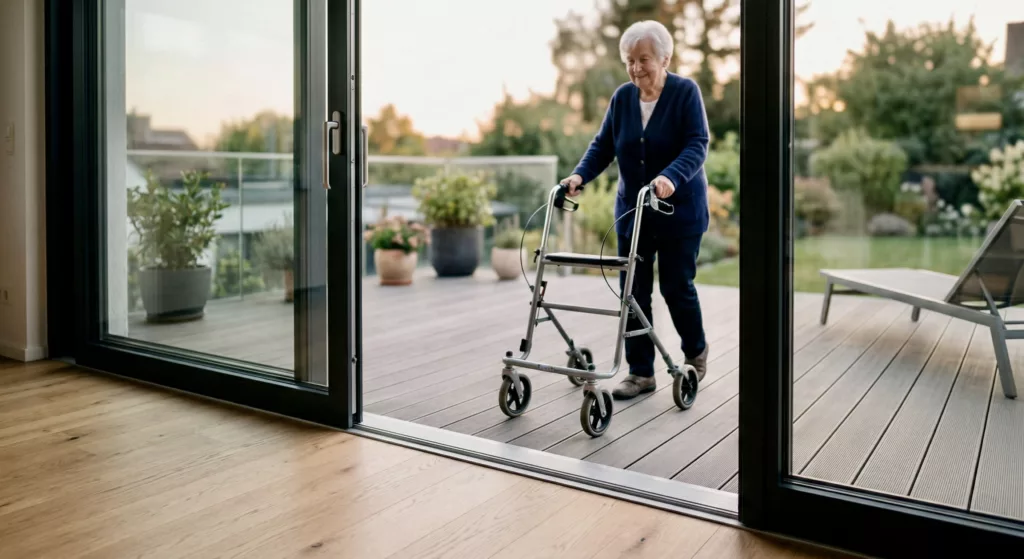
The key advantage of HST is the ability to create truly large glazed areas. A single sash can be up to 3 metres wide and weigh up to 400 kg, yet the whole thing operates with one finger. The threshold at just 48 mm height can be flush with the floor, creating a barrier-free transition between interior and terrace.
We offer systems including Aliplast Ultraglide with a frame thermal transmittance coefficient Uf of 0.93 W/(m²K). This parameter allows meeting energy-efficient building requirements even for windows exceeding five square metres in area.
Additional HST advantages include acoustic insulation reaching 47 dB and the possibility of achieving RC2 security class. The threshold equipped with ThermoTop technology achieves a Uf coefficient of 1.29 W/(m²K), eliminating the thermal bridge at this critical point.
Aluminium bi-fold doors – complete opening of space to the garden
If you dream of completely eliminating the boundary between your interior and garden, consider aluminum folding doors. Unlike HST, where you open up to half the width of the opening, the accordion allows you to open up to 95% of the space. The wings fold and slide to the side like an accordion, creating the effect of a disappearing wall.
The Aliplast Panorama system achieves a heat transfer coefficient Uw of 0.9 W/(m²K) with maximum sash dimensions of up to 1130 × 2600 mm. This is the perfect solution for winter gardens where you want to fully open up the space during summer parties or barbecues.
However, bi-folds require more space for the folded sashes and have a slightly higher threshold than HST. The decision between these systems depends on priorities: HST for maximum weather-tightness and minimal threshold, bi-folds for maximum opening.
See offer: Aluminium patio doors
Mistake #4: Aluminium profiles without thermal breaks – how thermal bridges cause moisture problems
Aluminium is a material with exceptional structural properties – it’s lightweight, strong, doesn’t rust, and requires no maintenance for decades. However, it has one disadvantage: it’s an excellent heat conductor. And it’s precisely this property that becomes a problem in wintergardens if not properly addressed.
Why cold aluminium creates condensation problems
Imagine a winter morning: minus five degrees outside, a comfortable twenty inside. The temperature difference is twenty-five degrees. An aluminium profile without a thermal break transfers this difference instantly – the internal surface of the profile has practically the same temperature as the external surface.
What happens when warm, moist air from inside touches a cold surface? Exactly the same as when you take a cold bottle from the fridge – water vapour condenses on the surface. In a wintergarden, this water collects on the profiles and begins to run down. Over time, surrounding timber gets wet, render darkens, and mould appears in corners.
Profiles without thermal breaks, colloquially called “cold aluminium”, have another problem. In winter, their internal surface is so cold that near the profiles the air temperature drops sharply. An unpleasant draught forms, which you feel as a cold current despite sealed windows. You sit in an armchair by a beautiful large-format window and feel the cold draught from the glazing side.
Thermal breaks in aluminium profiles – the barrier interrupts heat flow
The solution is a thermal break – an insert of material with low thermal conductivity that separates the external and internal parts of the profile. Most commonly, glass fibre-reinforced polyamide is used – a mechanically strong material that conducts heat much more poorly than aluminium.
The thermal break acts like an insulating barrier interrupting heat flow between the external and internal parts of the profile. The wider the thermal break, the better the insulation. Standard systems have thermal breaks 24 millimetres wide; premium systems reach 28-34 millimetres.
The structural profiles we use for wintergarden construction are equipped with multi-chamber thermal breaks ensuring a Uw coefficient for the entire construction from 1.6 W/(m²K) for the roof. This parameter allows year-round use of the wintergarden without problems with condensation or excessive heat loss.
Warm installation – without it, even the best profiles lose their properties
Even the best profiles with thermal breaks won’t help if they’re poorly installed. The thermal bridge you eliminate in the profile can form at the point where the structure meets the building wall.
Warm installation means the entire wintergarden structure is set in the building’s thermal insulation layer, not directly in the masonry. Special system sub-frames, expansion tapes, and insulating foams are used, creating a continuous thermal barrier around the entire construction perimeter.
Mistake #5: Ventilation and solar shading in wintergardens – why ventilation alone isn’t enough
“We’ll install fans in the roof and it’ll be fine” – this is one of the most costly oversimplifications in wintergarden construction. Ventilation is important, but if you treat it as the main solution to overheating, disappointment awaits.
Think about it this way: sunlight entering through the roof delivers energy equivalent to several powerful electric heaters. No reasonable ventilation can remove such an amount of heat – it would have to work with gale force, which would be uncomfortable and noisy. And in winter, the same ventilation would release expensive heat outside.
External solar shading – the only effective protection against overheating
The only truly effective method of combating overheating is stopping solar energy before it penetrates inside. When a ray of sunlight passes through glass and hits the floor or furniture, it converts to heat trapped in the enclosed space. But if the same ray is reflected or absorbed outside the building, the heat disperses into the air and doesn’t warm the interior.
That’s why solar shading must be installed externally, not internally. Curtains, internal blinds, even inter-pane blinds – all these solutions work only after solar energy has penetrated the building. They can reduce glare and provide privacy but offer minimal protection against overheating.
Roof awnings – protection from overhead sun
The wintergarden roof receives the greatest dose of solar energy because the sun strikes it almost perpendicularly. A roof awning is essential here – technical fabric deployed above the glazing that creates shade across the entire roof surface.
A good roof awning should have an electric motor with wind sensor that automatically retracts it in excessively strong gusts. Without this protection, one proper storm can destroy the awning in minutes. A weather controller allows automatic deployment when solar radiation exceeds a set level – you don’t need to remember manual control.
External façade blinds and ZIP screens – protection for wall glazing
For south, east, and west-facing walls, external façade blinds work well, also called raffstore. These are horizontal aluminium slats that you can adjust to different angles. Fully closed, they provide complete sun protection and privacy. Tilted at an angle, they block direct rays but allow diffused light through and let you look at the garden. This is flexibility that neither awnings nor roller blinds provide.
Our façade blinds are equipped with technology that eliminates wind noise, ensuring comfort and functionality in all conditions.
An alternative is ZIP screens – technical fabrics tensioned in guide rails like roller blinds but installed externally. We use Serge Ferrari technical fabrics proven in luxury yachting and modern stadiums. The innovative ZIP system, working on the zip fastener principle, guarantees ideal tension and fabric stability even in strong winds. Their structure resembles a dense mesh: they block most solar energy but allow air through and partially the view. They work excellently with very large glazed areas where blinds would be impractical.
See offer: Sun shades
Mechanical ventilation with weather automation – complementing the climate system
When you already have external solar shading, ventilation becomes what it should be – a way to remove residual excess heat and exchange air. Fans at the highest point of the structure push warm air outside, whilst through inlet vents in the lower part, cooler air flows in from the garden.
This system works brilliantly in combination with external solar shading. The awning blocks most energy; ventilation removes what got inside. Temperature remains comfortable even on hot days.
The most convenient solution is weather automation linking all elements into one system. We use intelligent Somfy automation – the world leader in home control. Sensors measure temperature, solar intensity, and wind strength. The controller decides when to deploy the awning, when to lower the blinds, how strongly to activate ventilation.
You go on holiday and don’t worry about plants in the wintergarden. The system automatically maintains the right temperature. You return from work on a hot afternoon and find pleasant coolness because the awning deployed automatically as soon as the sun started blazing. In winter, the system monitors humidity – if it rises too much, it activates ventilation to prevent condensation on the glass.
This is what distinguishes a well-designed wintergarden from a glazed structure that looks beautiful but is unusable for half the year. The same materials, similar price – but completely different user experience.
Year-round wintergarden – summary of key technical parameters
Building a wintergarden is an investment for decades. It’s worth spending time considering the details that determine comfort of use.
Foundation for aluminium wintergarden
- Depth minimum 80-100 cm below frost line
- XPS thermal insulation under entire surface (10 cm)
- 2 cm expansion joint from house wall
- Stable support for construction weighing 6-8 tonnes
Triple-glazed packages for wintergarden
- North wall: triple glazing with double Low-E coating, Ug 0.5-0.7 W/(m²K)
- South wall: glass with Solar Control coating, low g-value
- Roof: Solar Control glass with warm edge spacer, optionally self-cleaning
- Warm edge spacer eliminating thermal bridge at glass edge
HST sliding doors and bi-folds for wintergarden
- HST system: maximum glazing with minimal 48 mm threshold
- HST premium parameters: Uw from 0.7 W/(m²K), Rw up to 47 dB
- Bi-fold doors: opening up to 95% of opening width
- Possibility of achieving RC2 security class
Structural profiles with thermal break
- Multi-chamber thermal break ensuring insulation
- Uw coefficient of roof construction: from 1.6 W/(m²K)
- Three-layer warm installation eliminating thermal bridges
Wintergarden climate system
- External solar shading (roof awning, façade blinds, ZIP screens)
- Mechanical ventilation as complement
- Somfy weather automation linking all elements
Plan your wintergarden
Every wintergarden is different – different location, orientation, size, and residents’ expectations. There’s no universal recipe that works everywhere. That’s why individual analysis and selection of solutions for the specific situation is so important.